

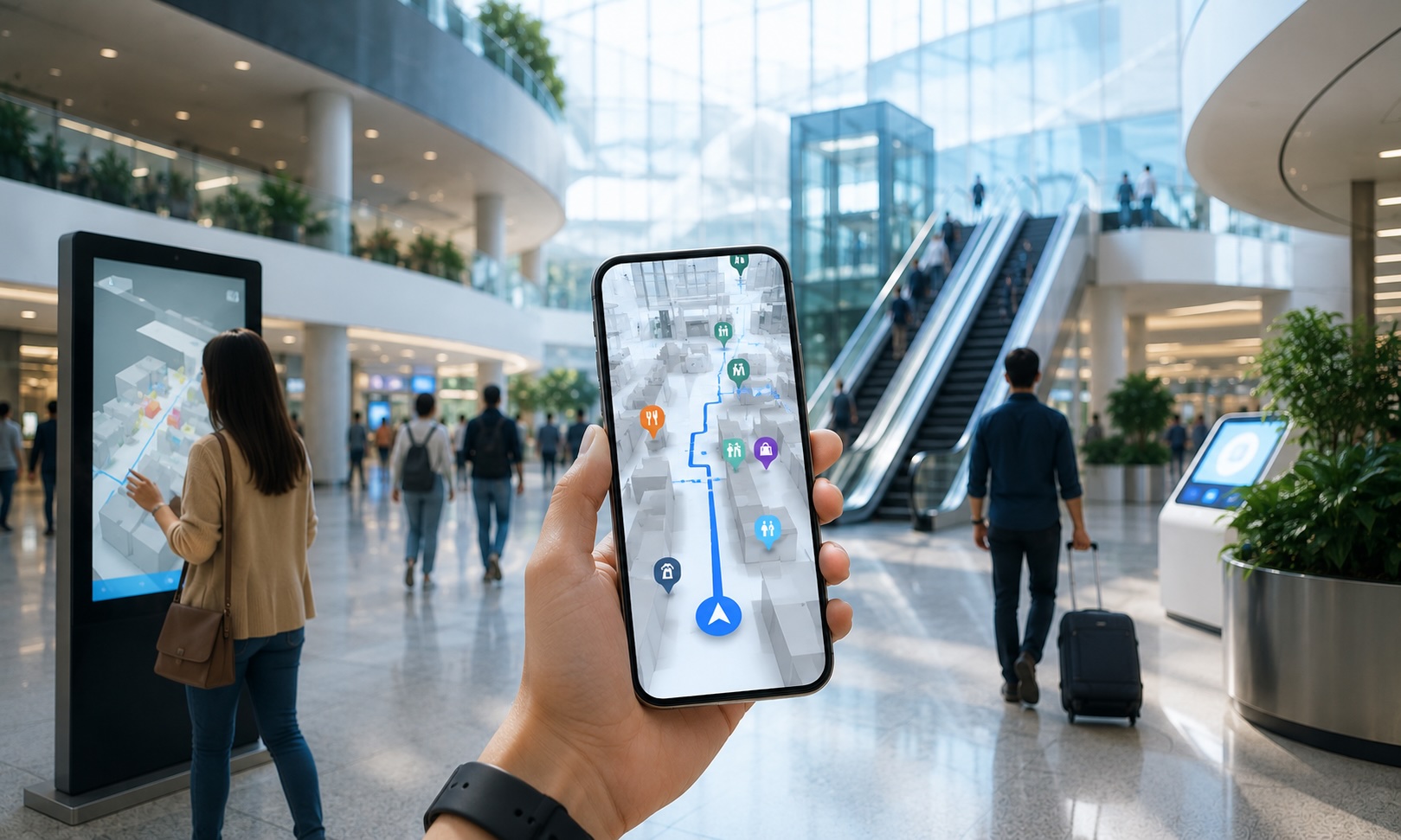

Getting lost indoors still happens more often than it should. People can use a phone to find the fastest route across town, track a delivery, or locate a parked car. Yet inside a hospital, airport, campus building, shopping center, or convention hall, visitors can still end up staring at a wall map and hoping they picked the right hallway.
That experience is changing. Current smart-space trends, indoor mapping use cases, and wayfinding technology research show that digital tools are making large physical environments easier to move through. Instead of relying only on static signs, organizations are using screens, kiosks, apps, sensors, and AI to guide people in real time.
Static Signs Are Giving Way to Smarter Guidance
Traditional signs are still useful. Exit signs, room numbers, and restroom markers help people make quick choices. The challenge is that many modern spaces change too often or cover too much ground for fixed signs to do the job alone.
Airports change gates. Hospitals move departments. Convention centers update floor plans for each event. Campuses may stretch across several buildings. Malls and entertainment venues need to direct people to stores, dining, parking, guest services, and event spaces.
That is where digital wayfinding is becoming a practical part of modern building design. These systems combine digital signage, touch-screen kiosks, mobile maps, indoor positioning, and real-time updates. A visitor can search for a destination, see the best route, and adjust if something changes.
The biggest benefit is confidence. A patient trying to find radiology should not feel more stressed before an appointment. A traveler should not miss a connection due to an outdated sign. A conference attendee should not need to ask three different staff members where a breakout room is located.
There is a brand benefit too. A place that is easy to navigate feels more thoughtful and polished. It shows that the organization values people’s time and comfort.
Digital navigation is not one screen in a lobby. It is a connected system of tools that work together.
Digital signage is often the first layer. Screens near entrances, elevators, hallways, and event areas can show maps, schedules, alerts, and directions. Unlike printed signs, the content can change when a room moves, an escalator closes, or crowds need to be redirected.
Interactive kiosks make the experience more personal. Visitors can search by department, store, booth, room, event, or service. In a convention center, that may mean finding booth 415. In a hospital, it may mean locating imaging services. In a university building, it may mean finding a lecture hall before class starts.
Mobile apps extend guidance beyond the kiosk. Visitors can plan a route before they arrive, save parking information, receive updates, and continue directions on their phone. For events, apps can also connect maps with agendas, exhibitor listings, speaker details, and alerts.
Indoor mapping is the technical layer that supports these tools. GPS works well outdoors, but it often struggles indoors. Indoor navigation may use Wi-Fi, Bluetooth beacons, QR codes, sensors, ultra-wideband, or visual positioning to determine a person’s location within a space. Some systems can also support turn-by-turn directions across multiple floors.
AI is making these systems more responsive. It can help analyze traffic patterns, predict bottlenecks, suggest alternate routes, and update content based on crowd flow. In a stadium, that might mean guiding guests to a less crowded entrance. In a hospital, it might mean sending visitors around construction. In a shopping center, it might mean helping guests find stores, events, or services faster.
Accessibility is one of the most valuable parts of modern navigation. Digital systems can offer step-free routes, elevator locations, larger text, high-contrast screens, voice guidance, and multilingual support. A static wall map rarely serves every visitor equally.
Research on augmented reality navigation shows how much this can matter. A 2025 hospital study found that AR-based indoor navigation helped users complete tasks faster, make fewer errors, and report lower anxiety and workload compared with paper maps. That points to a future where indoor navigation does more than save time. It can make stressful spaces feel easier to manage.
Better Navigation Is Becoming the Backbone of Smart Spaces
Smart spaces are not only about sensors, apps, or connected systems. They are about making physical environments work better for the people inside them. Navigation is one of the most useful places to start.
When wayfinding connects with other building systems, the experience becomes smoother. A screen can display the fastest route to the nearest open check-in desk. A campus app can point students to the closest shuttle stop. A venue can update walking paths when a hallway closes. A hospital can guide visitors away from restricted areas without confusion.
Organizations also gain better insight. Search data from kiosks and apps can show which destinations are requested most often. Traffic patterns can reveal where visitors slow down or get lost. Facilities teams can use that information to improve signs, staffing, floor plans, and service points.
Demand is rising as people expect indoor spaces to feel as easy to use as digital ones. Research and Markets reports that the digital wayfinding solutions market is valued at $1.18 billion in 2026 and projected to reach $1.75 billion by 2030. That growth reflects a larger shift toward connected buildings, smarter venues, and more visitor-focused design.
Physical Spaces Are Catching Up to Digital Expectations
People are used to getting clear directions in daily life. Now, that same expectation is moving indoors.
Digital technology is helping physical spaces become more responsive, accessible, and simple to navigate. Through signs, kiosks, maps, apps, sensors, and AI, organizations can guide visitors with more accuracy and less confusion.
The spaces that invest in smarter navigation will stand out. They will feel easier to enter, easier to understand, and easier to enjoy. In a world where experience matters, helping people find their way is not a small detail. It is part of what makes a place work.