


Key Takeaways
- Bancastato added bitcoin (BTC), ethereum (ETH), litecoin (LTC) and solana (SOL) without a separate exchange.
- Sygnum powers 25+ banks, signaling regulated crypto adoption is spreading across Switzerland.
- About 20 Swiss banks served 2.5M+ accounts by mid-2026; more integrations could follow.
Bancastato Brings Crypto Into Everyday Banking
The integration, Sygnum explained, places bitcoin, ether, litecoin, and solana inside the same web and mobile banking applications customers already use for deposits, investments, and day-to-day banking. That matters because one of the biggest barriers to bank-led crypto adoption has never been demand.
It has been the friction created when customers are forced to leave their bank’s ecosystem, complete another onboarding process, and manage assets on a separate platform. By keeping everything inside Bancastato’s existing interface, the experience feels like adding another investment product rather than introducing an entirely new financial relationship.
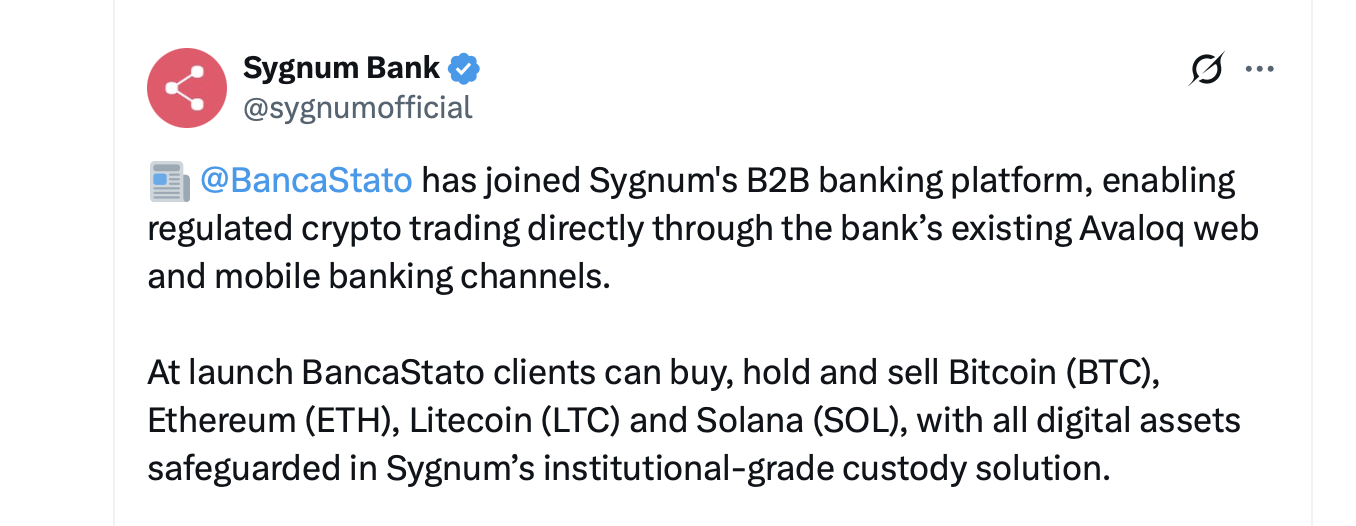
The arrangement also makes Bancastato the first bank using Avaloq’s software-as-a-service banking environment to offer cryptocurrency trading through Sygnum’s application programming interface, or API. In practice, that means the trading infrastructure operates behind the scenes while customers continue interacting with the same banking platform they already know.
Banks avoid rebuilding core systems, and customers avoid switching between applications every time they want to execute a trade. Customers can submit market orders based on either the amount of cryptocurrency they want or its value in U.S. dollars. Sygnum executes each trade while Bancastato maintains the customer relationship, branding, and front-end experience.
That separation reflects a model that has become increasingly common across regulated finance: Banks keep ownership of the client, while specialized providers handle the infrastructure that would otherwise require years of development, regulatory approvals, and ongoing maintenance. Sygnum also safeguards customers’ digital assets through its institutional custody platform.
Custody extends well beyond simply storing private keys. It involves layered security controls, governance procedures, independent audits, and legal structures designed to separate customer assets from a bank’s own balance sheet. Legal segregation has become one of the defining features that institutional clients expect because it helps reduce counterparty risk if a financial institution encounters operational or financial distress.
Sygnum Builds the Infrastructure Banks Do Not Have
Sygnum Chief B2B Officer Fritz Jost said the integration reflects growing demand for regulated digital asset services that plug directly into existing banking systems. He described Bancastato’s launch as “a significant step in the maturity and scalability of regulated digital asset infrastructure.”
Bancastato executive Curzio De Gottardi explained that adding digital assets broadens the bank’s existing investment offering. That observation reflects a wider shift across traditional finance. Many regional banks no longer view cryptocurrency as a standalone product competing with conventional finance. Instead, it increasingly sits alongside foreign exchange, equities, and managed portfolios as another asset class customers expect to access from a single account.
That strategy sits at the center of Sygnum’s business model. Rather than competing for retail deposits, the Zurich-based firm provides the trading, custody, compliance, and settlement infrastructure that partner institutions would otherwise need to design, build, and maintain internally. More than 25 banks and international financial institutions already rely on its business-to-business platform, including Zuger Kantonalbank, Luzerner Kantonalbank, Postfinance, and VZ Vermögenszentrum.
Sygnum says those partnerships already extend regulated digital asset services to more than one-third of Switzerland’s population through existing banking relationships. Bancastato expands that network into the country’s Italian-speaking region, reinforcing another trend that has emerged across Europe: Regional banks are increasingly adopting digital assets without abandoning their traditional role as community financial institutions.
A Zurich Startup Grows Into a Regulated Banking Network
Sygnum traces its origins to discussions held during the Singapore Fintech Festival in 2017. The company was incorporated in Switzerland in May 2018 and in Singapore a month later, establishing a dual-hub structure centered on Zurich’s banking sector and Singapore’s capital markets.
Zurich remains the company’s operational and regulatory headquarters, supporting custody, compliance, risk management, product development, and the technology powering partner institutions. Sygnum secured Swiss banking and securities dealer licenses in 2019, placing the company under the supervision of the Swiss Financial Market Supervisory Authority, or FINMA.
Its footprint has since expanded to licensed operations in Singapore, Abu Dhabi, and Liechtenstein. On June 30, Sygnum Europe obtained a crypto-asset service provider license under the European Union’s Markets in Crypto-Assets framework. Beyond opening additional markets, approvals like these reduce regulatory uncertainty for partner banks, giving them greater confidence that cross-border digital asset services can operate within a consistent legal framework rather than through fragmented local rules.
That expansion also highlights a practical reality inside traditional banking. Building institutional-grade cryptocurrency custody, compliance, and execution systems requires expertise that falls well outside most banks’ historical strengths. Many institutions have concluded it is faster, less expensive, and operationally safer to integrate proven infrastructure than attempt to recreate it from scratch.
Switzerland Moves Crypto Into the Mainstream
Bancastato’s rollout also mirrors Switzerland’s broader evolution into one of the world’s more mature regulated digital asset markets. Studies estimate that cryptocurrency ownership is between 18% and 23% of Swiss residents, with participation climbing to roughly 36% among some people ages 18 to 24.
By mid-2026, roughly 20 Swiss banks offered some form of cryptocurrency service across more than 2.5 million customer accounts, according to a Big Whale report published in March. UBS, Zürcher Kantonalbank, Postfinance, and cantonal banks in Zug, Lucerne, St. Gallen, Thurgau, and Ticino have all introduced regulated offerings, with many choosing specialized infrastructure providers instead of building proprietary platforms.
That pattern illustrates how Switzerland has approached digital assets differently from many jurisdictions. Rather than creating a parallel financial system, regulators have largely folded cryptocurrency into existing banking supervision through licensing standards covering custody, trading, compliance, and anti-money laundering (AML) requirements.
Combined with the concentration of blockchain firms around Zug’s Crypto Valley, the framework has given financial institutions a clearer path toward launching regulated services without rewriting their entire operating model.