

Retail investors
increased their exposure to energy, mining, and software stocks in the first
quarter of 2026, according to new data from eToro. The platform analysed
changes in the number of holders across listed companies, as well as the most
widely held stocks during the period.
Singapore
Summit: Meet the largest APAC brokers you know (and those you still don’t!).
The shift was driven by
demand for assets linked to geopolitics, energy security, and artificial
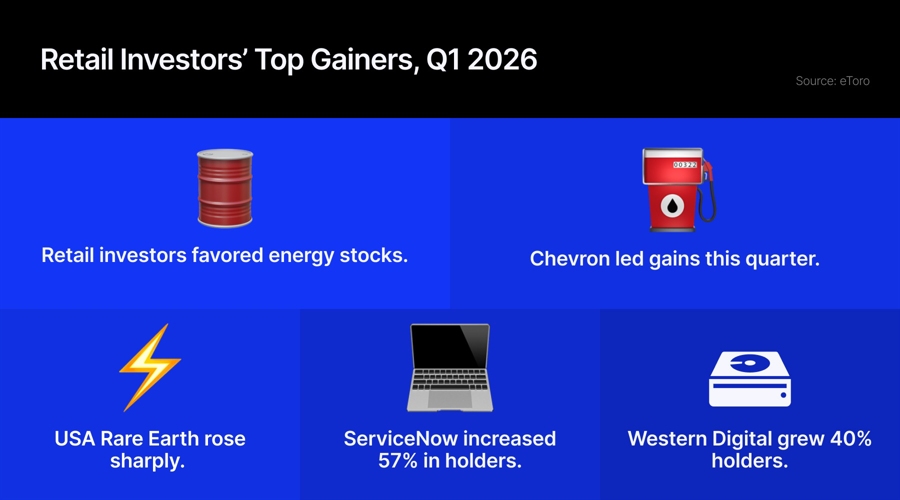
intelligence. Chevron led the “top risers” with a 60% increase in holders,
benefiting from US policy developments in Venezuela and rising oil prices
following conflict involving Iran.
USA Rare Earth followed with a 59% increase,
reflecting supply constraints and growing demand for domestic rare earth
production.
Retail Investors
Rotate into Commodities, AI
Enterprise
software and infrastructure firms also featured. ServiceNow recorded a 57% rise
in holders, while Western Digital saw a 40% increase, indicating continued
interest in companies linked to AI deployment.
Other
commodity and defence-linked names also gained. Freeport-McMoRan rose 43%,
supported by demand for gold and copper, while AeroVironment increased 38%,
reflecting interest in defence technologies.
Lale
Akoner, Global Market Strategist at eToro, said “the defining feature of Q1 was
not just geopolitical risk, but how that risk is being priced through real
assets,” adding that there is “a repricing of strategic commodities such as
gold, energy, and critical minerals.”
She said investors are “not reacting
tactically, but reallocating structurally,” with “a clear rotation towards
assets with pricing power and supply-side constraints.”
Investors Stay
Selective Amid AI Optimism
The
“top fallers” list included BioMarin Pharmaceutical, which recorded a 25%
decline in holders, followed by Okta, which fell 22%. Consumer-facing firms
such as Under Armour, down 19%, and Chipotle Mexican Grill, down 18%, also
declined, as higher costs and weaker demand visibility weighed on sentiment.
Akoner said investors are showing “less tolerance for earnings volatility and
weakening guidance,” with some sectors facing “higher input and freight costs”
and “softer demand visibility.”
The
ranking of the most widely held stocks remained largely stable. NVIDIA held the
top position, followed by Tesla and Amazon. Microsoft moved from fifth to
fourth place after an 11% increase in holders, while Apple slipped to fifth.
Alphabet saw limited change.
The stability suggests retail investors continue
to hold core positions in large technology companies tied to AI development and
monetisation.
Akoner
said concerns about a “SaaSpocalypse” have not reduced interest in software,
noting that “it’s made investors more selective,” with “capital concentrating
in companies that can either enable AI or sit at the application layer.”
This article was written by Tareq Sikder at www.financemagnates.com.
Source link