

By Eric Green, CEO of Trace Neuroscience, as part of the From The Trenches feature of LifeSciVC
Few neurodegenerative diseases have clearer genetic causation than Huntington’s disease (HD). And yet for decades, translating that genetic clarity into desperately needed effective therapies has proven frustratingly difficult.
This critical gap sets the backdrop for the recent public controversy surrounding uniQure and its investigational gene therapy, AMT-130. AMT-130 is an AAV5-delivered miRNA gene therapy for Huntington’s disease, administered via direct stereotactic injection into a patient’s striatum. It works by lowering huntingtin protein levels in the brain.
According to uniQure, the company reached agreement with FDA on a pivotal study design that would compare treated patients to subjects from a natural history dataset. By this measure, their trial achieved some successes, most notably an apparent slowing of disease progression. However, uncertainty about the extent of clinical benefit remains for reasons such as the small sample size (12 patients on the high dose reached the 36 month endpoint), heterogeneity across clinical and biomarker endpoints and the potential for persistent differences between the treated patients and natural history controls. The agency’s recommendation, for now, seems unambiguous: conduct a prospective, randomized, sham-controlled trial.
This controversy highlights the vulnerability of drug developers to shifts in regulatory policies during the long timelines of clinical trials. It also raises questions about what it means to conduct rigorous, ethical, and feasible clinical trials in people with HD and other rare, severe diseases.
Lost in the regulatory headlines, however, may be a more important story. A broader trend of accelerating progress in drug discovery and development for HD is unfolding, and it holds promise well beyond the fate of any single therapy.
Indeed, HD may be approaching a drug discovery inflection point. The field today sits at the convergence of three forces rarely aligned in neuroscience: human genetic validation of therapeutic targets, mechanistic insight from cutting-edge single-cell biology, and a rapidly expanding set of therapeutic modalities capable of reaching those targets.
Together these form what might be called a triad of therapeutic conviction:
- Human genetics nominates the targets
- Single-cell biology explains why those targets matter at the cellular level
- Advances in modalities enable us to actually drug them
Each pillar of this triad has been strengthened for HD over the past five years, and, critically, they reinforce one another.
Pillar 1: Human Genetic Validation of Targets
When HTT was identified as the causal gene for HD in 1993, it marked one of the earliest examples of a neurodegenerative disorder traced to a single gene mutation. Expansion of a CAG trinucleotide repeat in HTT beyond approximately 36 repeats causes HD with near-complete penetrance.
This level of genetic clarity contrasts sharply with diseases like Alzheimer’s, where decades of debate have surrounded the amyloid hypothesis, or Parkinson’s disease, where genetic subtypes such as LRRK2 or GBA account for only a fraction of cases.
But the genetic story in HD has progressed far beyond the causal mutation itself. Over the past decade, the Genetic Modifiers of HD (GeM-HD) Consortium has conducted large genome-wide association studies that have reshaped our understanding of disease progression and, in doing so, nominated a compelling set of therapeutic targets.
These studies identified more than twenty independent modifier signals that alter HD age of onset independently of inherited CAG repeat length. Strikingly, the strongest signals converge on the DNA mismatch repair pathway, which governs somatic expansion of CAG repeats within neurons.
Several of the key modifier loci harbor DNA maintenance genes, including FAN1, MLH1, MSH3, PMS1, PMS2, and LIG1. Among these, three have emerged as particularly compelling therapeutic targets.
MSH3 encodes a mismatch repair protein that, counterintuitively, promotes somatic CAG repeat expansion. Genetic variants associated with reduced MSH3 activity delay disease onset and slow motor decline. Human population genetics suggests that partial reduction of MSH3 activity is tolerated, supporting the possibility of a therapeutic window for MSH3 lowering.
FAN1, located at the most statistically significant modifier locus, encodes a nuclease that protects against repeat expansion, directly antagonizing the pro-expansion activity of the MSH3–MutL complex.
PMS1, another component of the MutL complex, collaborates with MSH3 to drive repeat expansion.
These represent targets nominated not by animal models or pathway speculation, but by the genomes of thousands of HD patients, and they reveal the molecular levers that accelerate or slow disease progression in humans.
Pillar 2: Mechanistic Insight from Single-Cell Biology
If human genetics tells us what drives HD, recent single-cell biology has begun to reveal how.
The concept that somatic CAG repeat expansion might drive HD pathology has deep roots. In 2000, Kennedy and Shelbourne demonstrated in knock-in mouse models that a subset of striatal cells acquired somatic expansions up to three times larger than the inherited allele, and that this instability was age-dependent and highly tissue-specific. The critical link to disease severity came in 2009, when Swami et al. showed that individuals with a greater burden of large somatic expansions in cortical DNA experienced earlier disease onset than predicted by their inherited repeat length alone. These observations, combined with the GeM-HD Consortium’s identification of DNA mismatch repair genes as the strongest modifiers of HD progression, built a compelling case that somatic expansion is not merely a byproduct of disease but a central driver of it.
What had been missing, however, was direct visualization of this process at the single-cell level in human tissue—a gap that recent advances have now begun to fill.
A recent landmark study from Steve McCarroll’s lab at the Broad Institute (Cell, January 2025) developed methods to simultaneously measure CAG repeat length and genome-wide RNA expression in individual cells from postmortem human brain tissue.
In striatal projection neurons (SPNs)—the cell population most vulnerable in HD—inherited CAG repeats of roughly 40–45 were observed to expand somatically to 100–500 or more repeats over the course of a lifetime. By contrast, expansion occurred far less frequently in striatal interneurons or glial cells.
This cell-type specificity offers a compelling explanation for the long-standing mystery of selective neuronal vulnerability in HD.
Perhaps the most important observation was the emergence of a functional threshold. SPNs with CAG repeat lengths below roughly 150 appeared largely normal. But once repeat lengths exceeded this level, neurons rapidly lost their molecular identity. They first shed positive neuronal markers, then activated stress and apoptosis pathways, and ultimately disappeared from the tissue.
These results connect human genetics directly to cellular pathology. Modifier genes in DNA repair regulate the expansion process occurring in the very neurons that die in HD.
For drug development, the implications are profound. They suggest that somatic expansion is a central driver of neuronal vulnerability, explain why reducing MSH3 or PMS1 activity may be protective, and imply a therapeutic window: intervene before neurons cross the critical repeat threshold and disease progression may be slowed.
Pillar 3: Expanding Modalities for Target Pharmacology
With genetically validated targets and mechanistic clarity about disease biology, the focus turns to translation: can we drug these targets?
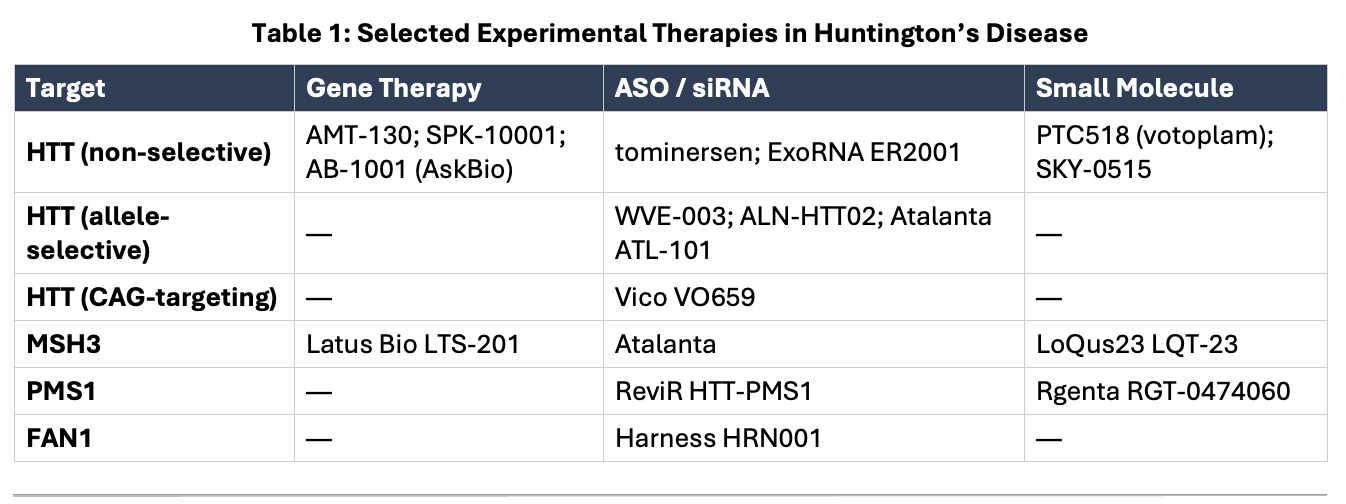
Here the HD field has benefited from a rapid diversification of therapeutic modalities. And each modality can be deployed against multiple targets, creating a rich matrix of complementary approaches.
Gene Therapy: One-Time Intervention
Gene therapy offers the potential for a single intervention capable of durably altering disease biology. The most advanced program targeting HTT is AMT-130 from uniQure discussed above. Regardless of the ultimate regulatory fate of AMT-130, the program provides an important proof-of-concept that has attracted additional entrants.
Gene therapy is also being applied to MSH3, where lowering the gene may halt the somatic expansion process itself. Latus Bio is developing an AAV-delivered microRNA targeting MSH3 using a proprietary capsid designed for efficient CNS delivery.
Nucleic Acid Therapeutics: ASOs and siRNA
Nucleic acid therapeutics represent one of the most pervasive modalities in HD. Multiple approaches are in clinical testing to directly silence the HTT transcript. Both antisense oligonucleotides (e.g. Wave, Roche/Ionis) and siRNAs (e.g. Alnylam, Atalanta) are being developed for this purpose. Because HTT may have an important biological role, some silencing approaches have been designed to selectively target the mutant allele. Alternatively, approaches to target CAG repeats directly (e.g. Vico) could selectively silence mutant HTT and potentially address other diseases caused by repeat expansions (such as spinal cerebellar ataxias).
Beyond HTT suppression, nucleic acid approaches are also targeting modifier genes. For example, Atalanta Therapeutics is developing divalent siRNAs designed to reduce MSH3, a strategy that blocks the somatic expansion process upstream of neuronal degeneration.
An alternative strategy is being pursued by Harness Therapeutics, which aims to increase expression of FAN1, enhancing a protective nuclease that counteracts repeat expansion.
Small Molecules: Oral and Scalable
Small molecules offer the possibility of oral, brain-penetrant therapies, avoiding intrathecal injections or neurosurgery.
In the HTT-lowering category, PTC518 (votoplam), a splicing modulator licensed by Novartis in a deal potentially worth over $1B including milestones, has advanced rapidly into late-stage development. Skyhawk Therapeutics’ SKY-0515 represents another HTT splicing-modulator approach and is currently being evaluated in a global Phase 2 study.
Small-molecule approaches are also emerging against modifiers of somatic expansion. Rgenta Therapeutics has presented preclinical work targeting PMS1, while LoQus23 Therapeutics is developing LQT-23, an allosteric inhibitor of the MSH3/MutSβ complex designed to directly block the expansion machinery.
A Portfolio of Approaches
Gene therapy, nucleic acids, and small molecules are each being deployed against HTT, MSH3, PMS1, and FAN1. Indeed, therapies combining more than one of these pathways (e.g. HTT and MSH3) are already in development. This diversification represents a meaningful shift from where the field stood even a few years ago.
The Convergence: Why Now?
What makes the current moment distinctive is not any single advance in isolation. It is the convergence of advances across genetics, mechanistic biology, and therapeutic technology. This alignment is rare in neuroscience.
Similar dynamics are beginning to appear in other neurodegenerative diseases. For example, in ALS and Frontotemporal Dementia, UNC13A is a target validated by human genetics to exacerbate disease progression. Two landmark studies in Nature implicated improper splicing of UNC13A mRNA as a pathologic mechanism, and splice-modulating antisense oligonucleotides are now in development. Identifying additional targets with this profile remains a critical goal for translational neuroscience. (Disclosure: I am the CEO of Trace Neuroscience, a biotech company developing medicines to restore UNC13A in people with neurodegenerative diseases).
From Setback to Setup
The regulatory debate surrounding uniQure’s AMT-130 will undoubtedly shape how treatments for HD navigate approval pathways going forward. But it would be a mistake to let that debate obscure the broader trajectory.
HD has never had this many scientifically grounded therapeutic programs advancing simultaneously across targets and modalities. At this pace, the next five years will produce an extraordinary wave of data from clinical trials targeting HTT, somatic expansion pathways, and protective modifiers.
For the HD community—patients, researchers, and the biotech ecosystem alike—the future will not be defined by any single regulatory decision. It will be defined by whether this scientific convergence finally translates into the first disease-modifying therapies for HD.