




Bitcoin 2026 opened at The Venetian on April 27 with the Director of the FBI in the program for a session about code, speech, and enforcement.
The placement turned a conference slot into a live test of Bitcoin’s political identity.
The session, titled Code is Free Speech: Ending the War on Bitcoin, took place at 10:30 a.m. on the Nakamoto Stage with Paul Grewal moderating and Acting Attorney General Todd Blanche.
Grewal moderated a virtual discussion with Patel rather than an in-person appearance.
Todd Blanche is the acting attorney general, serving as the 40th deputy attorney general.
The symbolism is clear. Bitcoin 2026 put law enforcement, a senior DOJ official, regulators, politicians, corporate treasury figures, and Wall Street digital-asset leadership inside the same cultural frame as a movement built around direct settlement and self-custody.
After years of Bitcoin being embedded into institutional operations it would be easy to caricature the push back as social-media outrage. Yet, I see a larger operating question.
Bitcoin has gained the type of legitimacy that earlier cycles wanted, including policy attention, public-company balance sheets, ETFs, and US reserve policy. The cost is that the public face of adoption now runs through many of the institutions Bitcoin was designed to reduce dependence on.
A policy win that also changes the room
The strongest case for the conference lineup starts with enforcement.
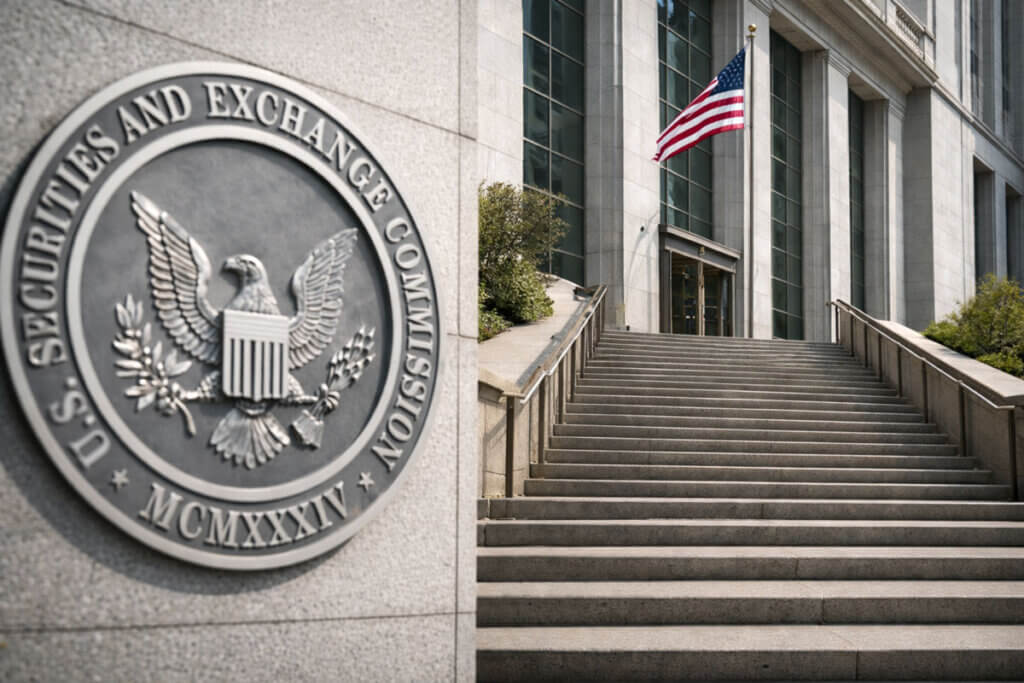
Blanche’s April 2025 Justice Department memo said the DOJ is not a digital-assets regulator and directed prosecutors away from regulation by prosecution. It also told the department to focus digital-asset cases on investor victims and criminal misuse.
The memo disbanded the National Cryptocurrency Enforcement Team.
That policy underpins the conference’s developer-friendly framing. Blanche and Patel used the Bitcoin 2026 discussion to signal a focus on crime rather than developers or code.
The same enforcement turn was already visible in CryptoSlate’s coverage of the administration’s deregulation of crypto enforcement, including the end of the national crypto enforcement unit.
Put simply, the government pitch was that developers should face less legal risk when they build neutral tools, while criminals using digital assets remain enforcement targets.
The claim speaks directly to an old Bitcoin concern. The Bitcoin white paper described a peer-to-peer electronic cash system that lets parties transact without going through a financial institution.
A movement built around that idea will always pay attention to where intermediaries re-enter the system. The code-speech session placed the question in legal terms.
Coin Center’s April 2026 letter to the SEC drew a speech-protection boundary around publishing software and neutral tools, while treating custody, unilateral control, and client-specific discretion as conduct that can move into regulable territory.
This gives the government side its strongest ground. If federal agencies reduce the risk that builders are treated as proxies for bad users, Bitcoin gains room to develop in the US.
If that legal relief arrives through the same state apparatus that many Bitcoiners distrust, the victory comes with a cultural price. The conference made both takes visible at once.
The distinction also explains why the panel became a flashpoint beyond legal policy. A developer-friendly enforcement posture can still feel like a state-mediated bargain when the venue is a Bitcoin stage.
Adoption now runs through institutions
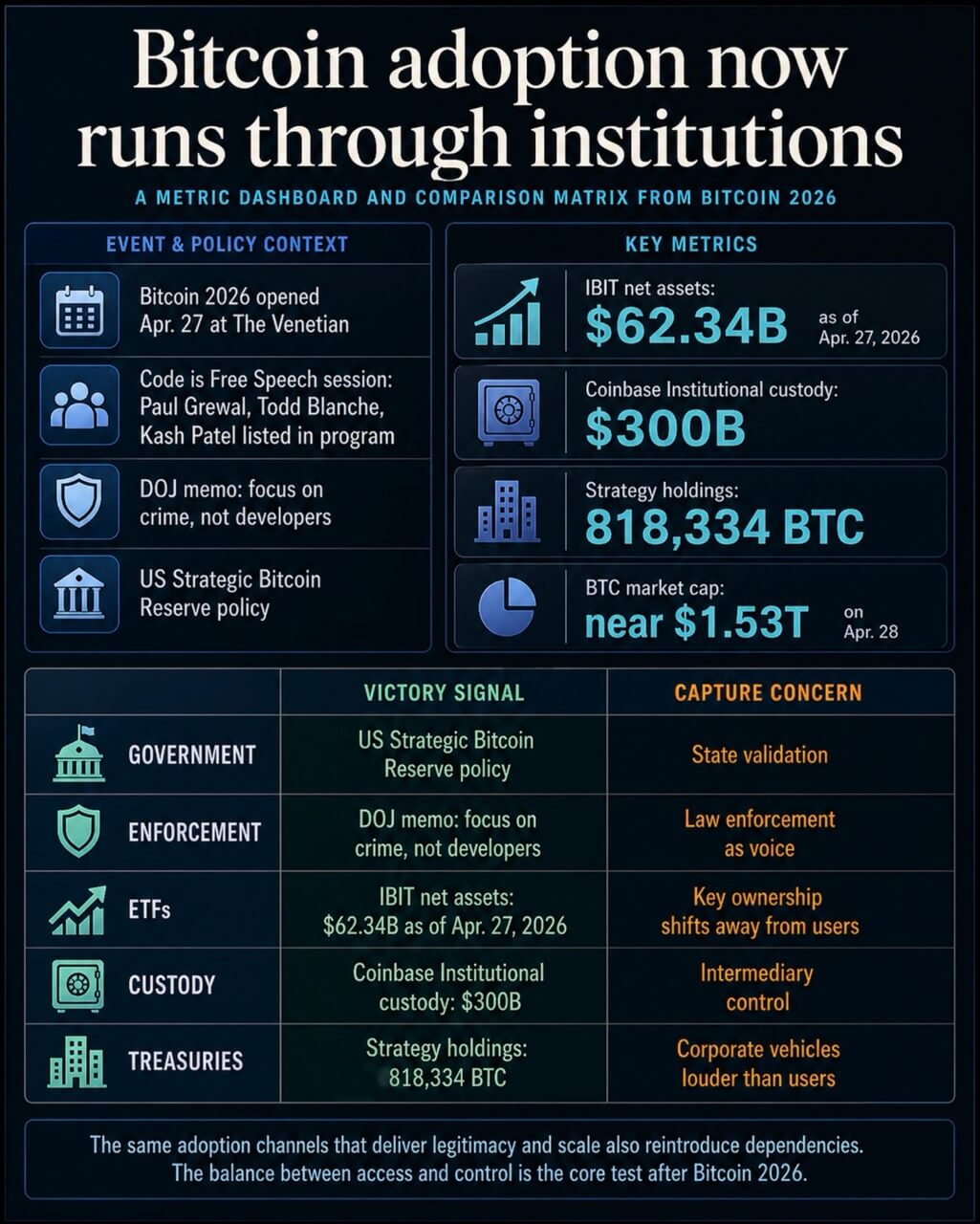
The White House’s 2025 Strategic Bitcoin Reserve order established a US policy for a Strategic Bitcoin Reserve and a Digital Asset Stockpile.
CryptoSlate market data shows Bitcoin around $76,258 as of press time, with a market capitalization near $1.53 trillion.
Regulated access has also become a major channel.
BlackRock’s iShares Bitcoin Trust ETF holds around $62.34 billion in net assets as of Apr. 27, 2026, and Coinbase Institutional lists $300 billion in assets under custody.

On the corporate-treasury side, Strategy announced on Apr. 27 that it had acquired an additional 3,273 BTC to bring its total holdings to 818,334 BTC.
Bitcoin now sits in public-company treasuries, ETF wrappers, custody platforms, and government policy.
A conference built around adoption will naturally pull in the people who operate those channels.
| Channel | Victory signal | Capture concern |
|---|---|---|
| Government | US policy treats Bitcoin as a strategic reserve asset. | State validation can shift the public narrative away from self-sovereignty. |
| Enforcement | DOJ language reduces pressure on developers and neutral tools. | Law enforcement becomes a featured voice in Bitcoin culture. |
| ETFs | IBIT gives investors regulated Bitcoin exposure at large scale. | Exposure can grow while direct key ownership becomes less common. |
| Custody | Coinbase gives institutions infrastructure for large positions. | Custody concentrates operational control in regulated intermediaries. |
| Treasuries | Strategy shows corporate balance sheets can absorb large BTC positions. | Corporate vehicles can become louder than individual users. |
The same adoption channels solve real problems and reintroduce old dependencies. That’s the structural tension behind the backlash, and it explains why the same data can read as progress to institutions and as drift to self-custody advocates.
Operationally, the tradeoff is visible in how exposure is delivered. More access can mean fewer users holding keys, fewer direct settlement habits, and more reliance on regulated operators.
The backlash is about who gets to speak for Bitcoin
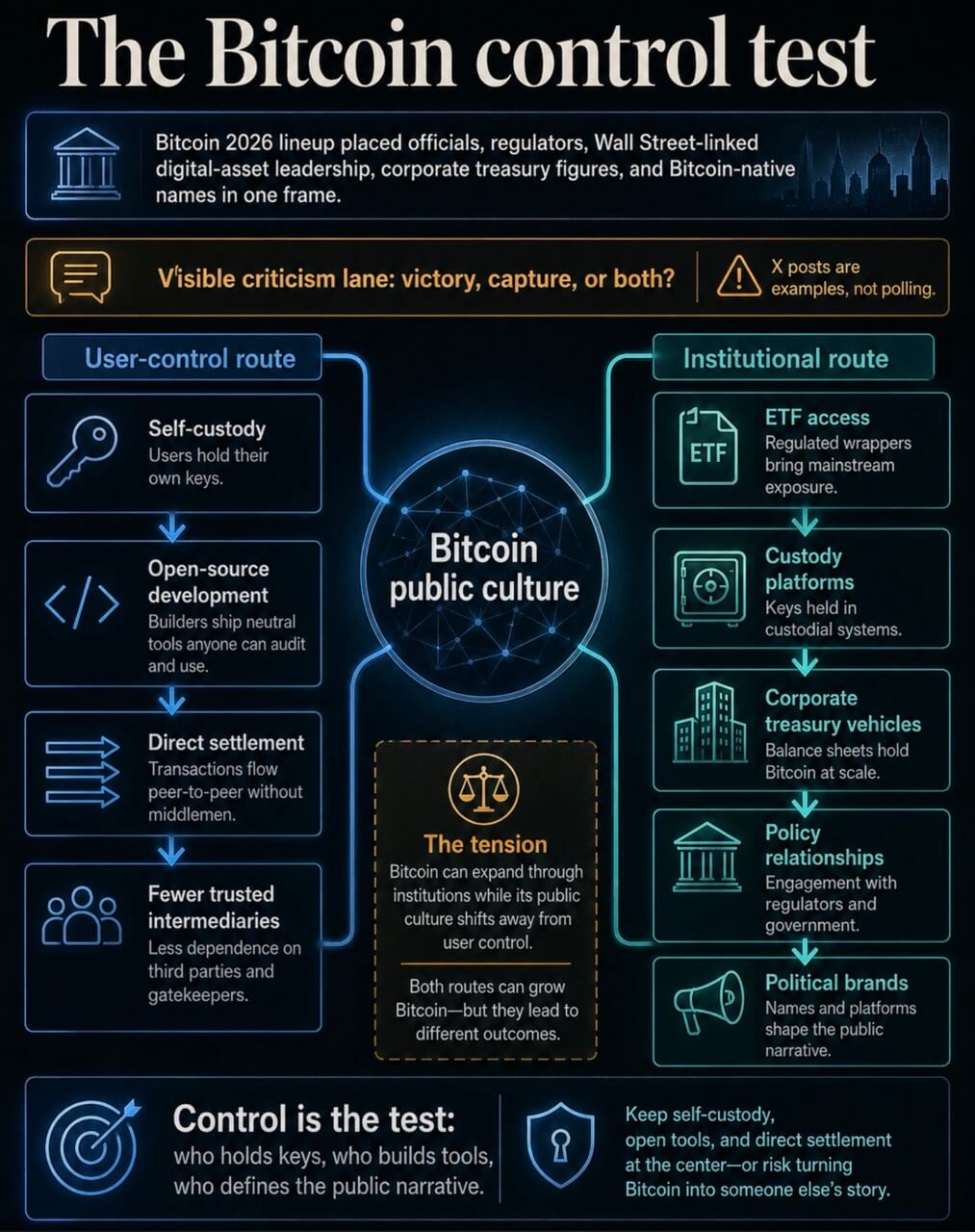
The official speaker presentation brought regulators, US officials, politicians, Wall Street-linked digital-asset leadership, corporate treasury figures, and Bitcoin-native names into one conference frame.
That breadth can be viewed as proof that Bitcoin won the legitimacy fight. It can also be seen as evidence that the protocol’s public culture is being packaged by institutions with different incentives from individual users.
The protocol can remain open while the story around it becomes more centralized.
Two X posts captured that concern in blunt terms.
One post from @BeTheChain, a self-described long-time Bitcoiner, attacked the conference for inviting federal officials. Another from crypto scam investigator, @MastrXYZ framed the speaker list as Bitcoin becoming the system it was built to escape, pointing to corporate balance sheets, regulators, political brands, Tether, Wall Street custody, and mining companies as signs of drift.
Those posts, and the Bitcoiners in the replies, identify a visible criticism lane. The objection is less about any single speaker than about representation.
If the most visible Bitcoin stage is filled by officials, ETF infrastructure, corporate treasury firms, and political brands, critics see a different movement from the one implied by self-custody slogans.
The self-custody dispute around Michael Saylor in 2024 showed how quickly Bitcoin’s adoption debate can turn into a fight over who speaks for users.
The strongest reply is practical. Bitcoin adoption at national and institutional scale was always going to involve law, custody, public markets, and politics.
A $1.5 trillion asset has moved beyond retail self-custody culture alone. The question is whether those channels remain access points to Bitcoin or become the venues that define it for everyone else.
Control becomes the next test
Bitcoin 2026 exposed an identity split that has been forming since BlackRock filed for its Bitcoin ETF in 2024 and accelerated when Donald Trump adopted Bitcoin as part of his official campaign strategy in the 2024 presidential election.
Still, two things can be true at once.
Government engagement can reduce legal uncertainty for developers. ETFs and custodians can broaden access. Corporate treasuries can absorb supply and normalize Bitcoin as a reserve asset.
Each of those outcomes looks like adoption working.
However, he same facts also support the capture critique. Regulated products can move users away from direct ownership. Corporate vehicles can dominate public attention.
Political figures can redirect the movement’s language into brand and access channels. Law enforcement can enter the cultural center of a movement that once defined itself by routing around state and financial intermediaries.
The practical test after the conference is control.
Users can keep meaningful self-custody, open-source development, and direct settlement at the center, allowing institutional adoption to expand the network without absorbing its core culture.

Convenience and access can also flow mainly through ETFs, custodians, treasury companies, and policy relationships, giving the capture argument more force.
Bitcoin’s public win is now large enough to create its own contradiction.
The institutions that users were once told they could route around are now helping explain it to the audience. For some Bitcoiners, that is the victory. For others, it is the warning sign.
Bitcoin 2026 showed that both camps are responding to the same change.