
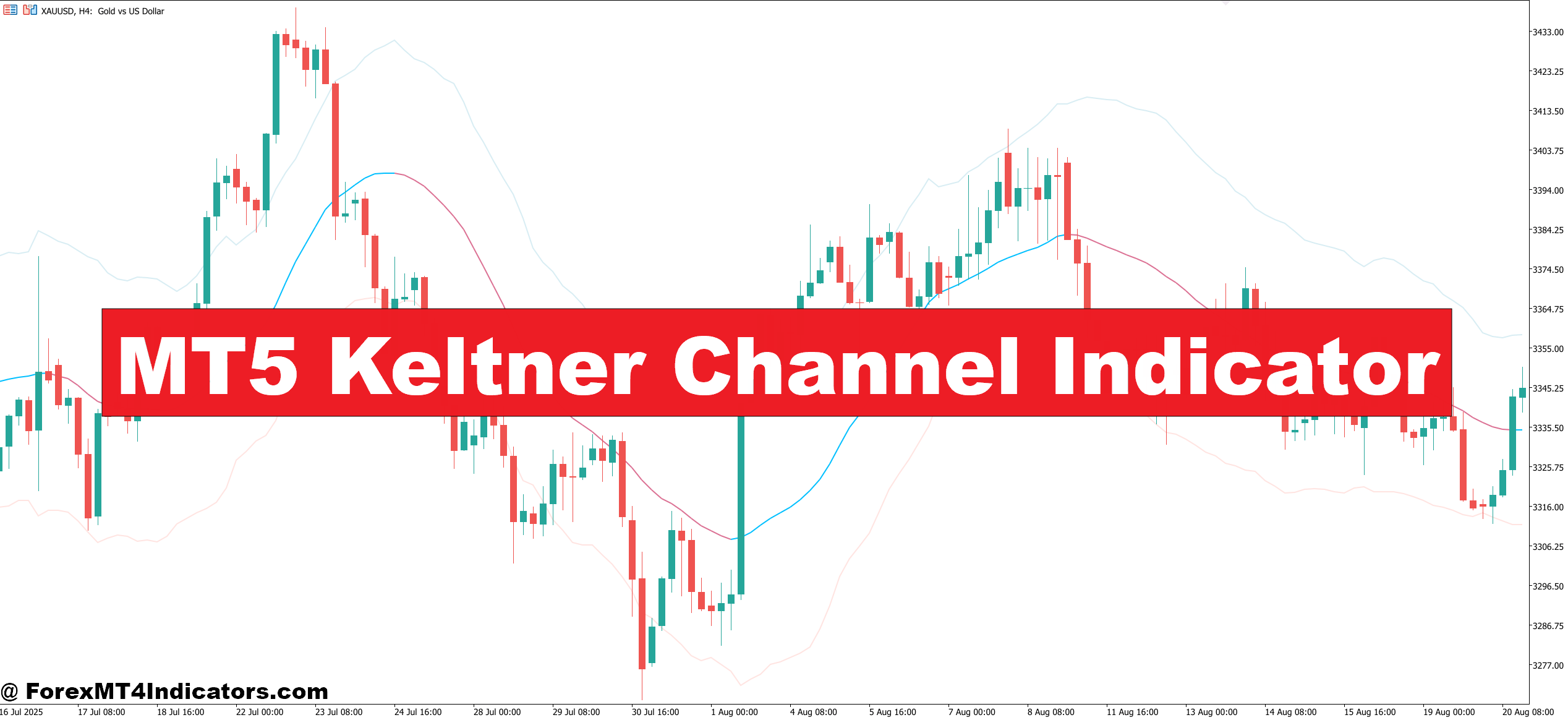

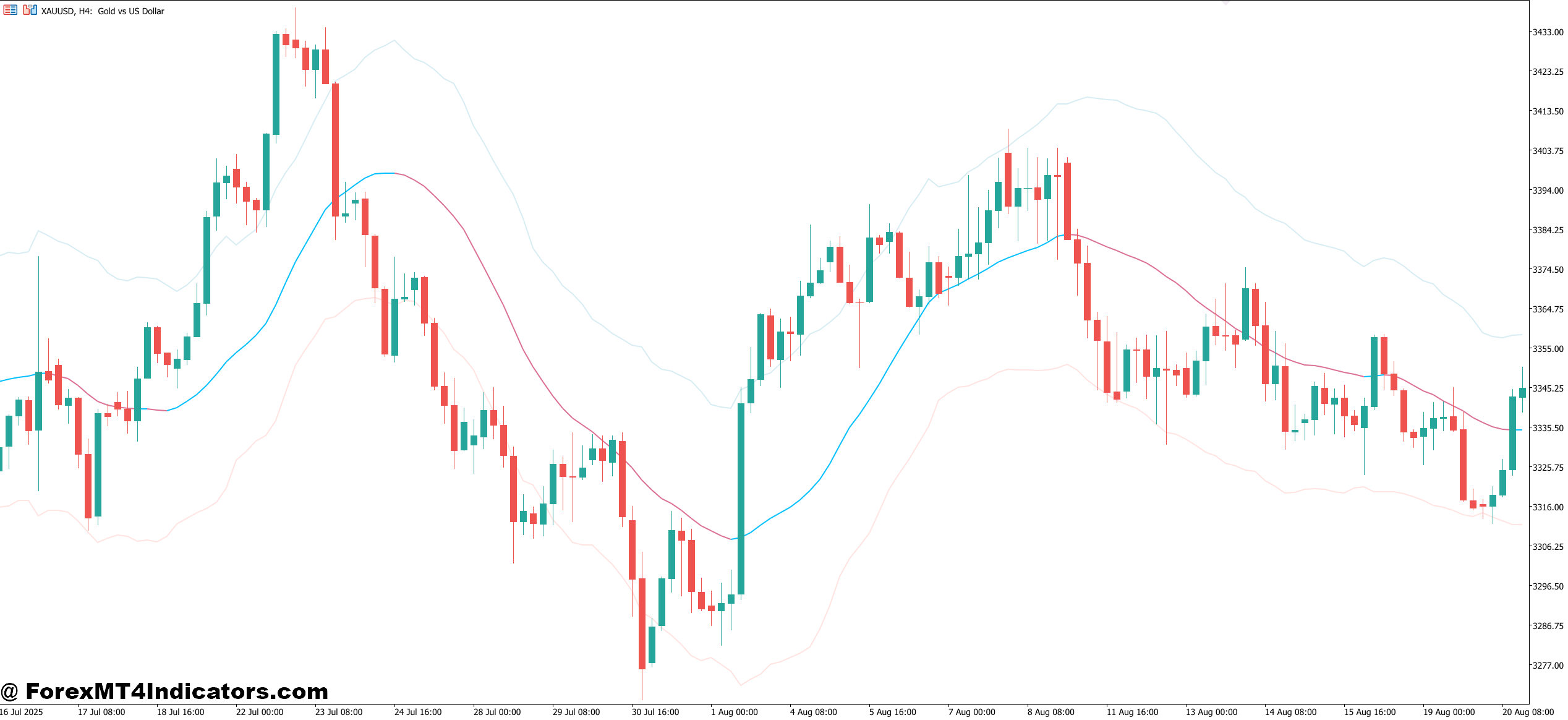
The MT5 Keltner Channel Indicator is a volatility-based technical analysis tool that plots three lines on the chart:
- A middle line (usually an Exponential Moving Average)
- An upper channel band
- A lower channel band
The middle line commonly uses a 20-period EMA. The upper and lower bands are calculated using the Average True Range (ATR), typically multiplied by a factor such as 2.0.
Unlike Bollinger Bands, which expand and contract based on standard deviation, Keltner Channels rely on ATR. That means they measure real market range movement rather than statistical dispersion. Many traders prefer this because ATR reflects actual price volatility.
In MT5, the MT5 Keltner Channel Indicator allows customization and smoother integration into multi-timeframe analysis. It works well for trend-following systems and breakout strategies.
How the Indicator Works in Live Market Conditions
At its core, the formula is simple:
- Middle Line = 20-period EMA
- Upper Band = EMA + (ATR × Multiplier)
- Lower Band = EMA − (ATR × Multiplier)
When volatility rises, ATR increases and the channel widens. During quiet sessions, like late New York on major pairs, the bands tighten.
Here’s a real-world example.
On GBP/USD 1-hour chart during an NFP Friday, price consolidated inside a tight 25-pip range before the news. The Keltner bands narrowed noticeably. Once the data hit, volatility spiked. A strong bullish candle closed above the upper band with ATR expanding sharply.
That breakout wasn’t random. The channel had compressed first. Expansion followed. Traders who waited for a candle close above the upper band with rising ATR had a structured entry, not an emotional one.
But here’s the thing: not every band break is tradable. During ranging markets, price may poke outside the channel and snap back inside. That’s a classic fake-out.
The indicator works best when combined with:
- Higher timeframe trend confirmation
- Clear support and resistance levels
- Strong momentum candles
Practical Trading Applications
1. Trend Continuation Entries
In a trending market, price often “rides” the upper or lower band.
For example, during a sustained uptrend on USD/JPY daily chart, price repeatedly pulled back to the 20 EMA (middle band) before pushing toward the upper channel again. Traders used the middle band as dynamic support.
A common strategy:
- Wait for price to retrace to the middle EMA
- Confirm bullish price action (engulfing candle or strong rejection wick)
- Enter long targeting the upper band
Stops usually sit below recent swing lows. Risk-to-reward often lands around 1:2 or better if volatility supports expansion.
2. Breakout Volatility Strategy
When bands squeeze tightly together, it signals low volatility. Breakouts from these compression phases often lead to sharp moves.
On EUR/USD 15-minute chart during London open, traders may see bands compress during Asian session. A strong break outside the channel with volume spike can signal session expansion.
But discipline matters. Enter only after candle close outside the band. Many traders get trapped entering mid-candle.
3. Mean Reversion in Ranging Markets
Some traders use it in reverse. If price spikes far beyond the outer band without trend support, they look for mean reversion back toward the EMA.
This works best in sideways markets. In strong trends, fading band breaks can be expensive.
MT5 Keltner Channel Indicator Settings and Customization

Default settings usually work well:
- EMA Period: 20
- ATR Period: 10 or 14
- Multiplier: 2.0
But adjustments matter.
For scalping on 5-minute charts, some traders reduce EMA to 14 and ATR to 10 for quicker responsiveness. On higher timeframes like 4-hour or daily, increasing the multiplier to 2.5 helps filter noise.
Exotic pairs like GBP/NZD tend to have higher volatility. A 2.5 or 3.0 multiplier may prevent constant false band breaks.
During backtesting, one trader found that EUR/USD 1-hour performed best with:
- 20 EMA
- 14 ATR
- 2.2 multiplier
That slightly wider band reduced whipsaws during choppy European afternoons.
Settings aren’t universal. Market structure and pair volatility matter more than “perfect” numbers.
Advantages, Limitations, and Comparison
Advantages
- Clear volatility measurement
- Dynamic support and resistance zones
- Works well in trending markets
- Easy to combine with RSI or MACD for confirmation
Because it uses ATR, it reacts naturally to real price expansion. Many traders find it smoother than Bollinger Bands.
Limitations
- Generates false signals in tight ranges
- Doesn’t predict direction, only volatility context
- Needs confirmation from price action
During sideways chop, price may cross bands repeatedly. That leads to frustration if traders rely on it alone.
Keltner Channel vs. Bollinger Bands
Bollinger Bands expand based on standard deviation. They react faster to sharp spikes. Keltner Channels respond to ATR, making them smoother.
What makes this different? Keltner Channels often provide cleaner trend-following signals. Bollinger Bands are more popular for mean reversion setups.
Neither is superior in all conditions. It depends on the trading style.
Risk and Money Management Considerations

Trading forex carries substantial risk. No indicator guarantees profits.
The MT5 Keltner Channel Indicator helps structure entries, but risk control still defines survival. Many experienced traders risk no more than 1–2% per trade. They place stops beyond logical structure, not just beyond the band.
During high-impact news events like FOMC or CPI releases, volatility can distort ATR temporarily. That may stretch bands and create misleading entries.
And no volatility tool replaces patience.
How to Trade with MT5 Keltner Channel Indicator
Buy Entry

- Buy on upper band breakout with volatility expansion – Enter when a 1-hour candle closes at least 5–10 pips above the upper band on EUR/USD and ATR(14) is rising; this confirms real momentum, not a weak poke.
- Buy pullback to middle EMA in uptrend – On the 4-hour GBP/USD chart, wait for price to retrace to the 20 EMA (middle line) and print a bullish rejection candle; place stop 20–30 pips below recent swing low.
- Buy after band squeeze breakout – When bands compress tightly (less than 30-pip width on 1-hour chart), prepare for expansion; enter on strong close outside upper band with target 1.5–2x risk.
- Buy with higher timeframe trend alignment – If daily trend is bullish and 1-hour price breaks above upper band, trade in direction of the larger move to avoid countertrend traps.
- Buy on strong bullish candle close – Enter only after full candle close above upper band; don’t jump in mid-candle or you risk a fake-out during London or NY volatility spikes.
- Buy with RSI confirmation – If RSI(14) stays above 55 while price rides upper band on GBP/USD 4-hour chart, it supports continuation; avoid if RSI shows bearish divergence.
- Buy on retest of broken band – After breakout, wait for price to retest the upper band as support; if it holds within 10–15 pips, enter with tighter stop for better risk-to-reward.
- Risk control before entry – Never risk more than 1–2% per trade; skip signals during major news (NFP, CPI) when spreads widen and ATR spikes artificially.
Sell Entry

- Sell on lower band breakout with strong momentum – Enter when a 1-hour candle closes 5–10 pips below the lower band on EUR/USD with expanding ATR; confirms bearish pressure.
- Sell pullback to middle EMA in downtrend – On GBP/USD 4-hour chart, wait for price to retrace to 20 EMA and form bearish engulfing; stop 25–35 pips above recent swing high.
- Sell after volatility squeeze break – If bands tighten under 25–30 pips range on 1-hour chart, prepare for breakout; enter short after strong close below lower band.
- Sell with daily trend confirmation – If daily structure shows lower highs and lower lows, short signals on 1-hour band breaks carry higher probability.
- Sell rejection at upper band in range – In sideways markets, if price spikes 15–20 pips above upper band and closes back inside, consider short toward middle EMA; avoid this in strong trends.
- Sell with bearish RSI confirmation – If RSI(14) stays under 45 while price rides lower band on 4-hour chart, it supports continuation; avoid when RSI shows bullish divergence.
- Sell retest of broken lower band – After breakout, wait for price to retest lower band as resistance within 10–15 pips; enter with defined stop above band for controlled risk.
- Avoid overtrading in chop – If price crosses bands multiple times within 10–15 candles on 1-hour chart, stand aside; repeated band touches signal range, not trend.
Conclusion
The MT5 Keltner Channel Indicator gives traders a structured way to read volatility and trend behavior. It frames price action instead of leaving it floating on the chart.
Key takeaways: it uses EMA and ATR to create dynamic bands, it performs best in trending or breakout conditions, settings should match pair volatility and timeframe, and it works stronger when paired with solid price action analysis.
Used wisely, this indicator can improve entry timing and reduce emotional trades. But it isn’t a shortcut. Traders still need risk control, backtesting, and discipline. Add it to a demo account, test it across market sessions, and see how it behaves during real volatility shifts before committing capital.
Recommended MT4/MT5 Broker
XM Broker
- Free $50 To Start Trading Instantly! (Withdraw-able Profit)
- Deposit Bonus up to $5,000
- Unlimited Loyalty Program
- Award Winning Forex Broker
- Additional Exclusive Bonuses Throughout The Year
- Exclusive 90% VIP Cash Rebates for all Trades!

>> Sign Up for XM Broker Account here with Exclusive 90% VIP Cash Rebates For All Future Trades [Use This Special Invitation Link] <<
Already an XM client but missing out on cashback? Open New Real Account and Enter this Partner Code: VIP90