
By Arthur Tzianabos, CEO of Lifordi Immunotherapeutics, as part of the From The Trenches feature of LifeSciVC
We work in a serious business — endeavoring to make people’s lives better and, in some cases, literally saving lives. It is a high-stakes, high-pressure job, but fortunately, biotech veterans are a resilient species. We have developed and delivered many life-changing therapies for patients, all while knowing that most drugs never make it to market. But that doesn’t stop us from trying.
We know it takes $1–$3 billion and 10–15 years on average to develop a drug. We do our best to control time and money, but as I often remind my teams: “We are at the mercy of biology.” Not as an excuse — but as a reality check. It’s a hard job that requires enormous perseverance. And it’s a job that’s far easier to sustain with a regular dose of an age-old medicine — one that has proven safe and effective in minimizing frustrations, alleviating suffering, and improving outcomes, all with no serious adverse events or TEAEs.
So what is this mystery medicine?
Biotech Trivia Challenge
See if you can identify it from these clues:
- First discovered ~300,000 years ago
- Translated well from NHPs to humans
- Studied extensively in randomized, open-label trials — daily, biweekly, and monthly doses tested; maximum tolerated doses varied
- Safe and well tolerated in healthy volunteers and patients alike
- Excellent PK/PD profile: rapid uptake, long exposures, and positive systemic effects
- Few contraindications — though mixing with excess alcohol at company celebrations is not advised
- ADAs can develop over time but are not known to diminish effectiveness
- Works well in infants, children, and adults
- Easy to administer, though sometimes tough to take
- Best when taken daily, though biweekly and monthly dosing is common
- Available OTC — no prescription required
- Everyone benefits from its “freedom to operate”
- Addresses high unmet needs
- Costs nothing to develop, manufacture, or sell — yet delivers an impressive ROI
The answer? Humor — and its most common form of expression: laughter.
Why Humor Matters in Biotech
Humor may not be a cure-all, but it is a potent survival drug, particularly for emerging biotech companies. It is made from natural ingredients, can be administered by any team member, and should be injected directly into a company’s culture. Results show that its systemic effects make work — and by extension, home life — measurably better.
Humor is in our DNA. And it should be our MOA. I believe great leaders should model this behavior. We need to embrace it, cultivate it, and value it, because it truly is the best medicine.
Humor Builds Trust and Social Connection
Years of research cite the benefits of humor in activating the release of oxytocin, the “bonding hormone” associated with trust and social connection. Humor creates an environment where people feel safe speaking out, sharing challenges, admitting mistakes, asking for help, and taking creative, calculated risks in search of better outcomes.
Interestingly, these are the very same qualities that often determine whether a drug candidate survives.
It is important, however, to note the distinction between laughing at the experience of doing hard work and laughing at the people or the work itself. Knowing and respecting that difference can determine whether you build organizational resilience — or quietly destroy it.
Humor Improves Physical and Mental Health
Humor is not trivial. There is a large and growing body of scientific and medical literature supporting its physical and mental health benefits. It relieves stress, improves mood, eases tension, and enhances immune function.
In Mayo Clinic: Stress Relief from Laughter? It’s No Joke, the authors highlight associations between laughter and reductions in stress hormones such as cortisol. Humor also increases serotonin, dopamine, and endorphins — the chemicals associated with happiness — and has positive effects on immune and cardiovascular functioning.
In her book The Brain That Loves to Laugh, Dr. Jacqueline Harding notes that laughter precedes the neural development of speech and engages a distributed network of brain regions, including the motor areas and prefrontal cortex. Other studies support humor’s role in increased learning, engagement, and memory.
The science is clear: laughter isn’t a distraction from serious work. It makes serious work more sustainable and enjoyable.
Humor Offers a Level Playing Field
While not everyone holds the same job title, everyone is an employee — and shared moments of fun can bring executives, scientists, and staff together in ways that formal meetings rarely do. Informal gatherings are fertile ground for humor, and the benefits extend well beyond the fun itself.
This is perhaps nowhere more evident than in the fishing expeditions, road relay races, and White Mountain hiking adventures that Bruce Booth at Atlas champions each year. He has gotten fun down to a science and clearly yields great results by bringing our ecosystem together for fun outdoor excursions.
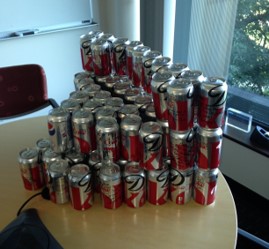
At Shire, we celebrated Pi Day — everyone brought in pies. The creativity and humor people brought to these events produced long-lasting smiles and lasting bonds. On one occasion, a colleague decorated a pie with the exact timestamp of Pi — March 14, 2015 at 9:26:53 AM — rendered perfectly in icing. The humor in my group continued right up until my last day at Shire, when I walked into my office to find a carefully constructed pyramid of Diet Coke cans on my desk, each one with a personal message for me written with a Sharpie. It was the perfect parting gift for someone who doesn’t drink coffee but runs on caffeine. People had long joked that you could gauge my mood by counting the empty Diet Coke cans lined up on my desk. If you look at the picture closely, one joker wrote his message on a Diet Pepsi can knowing I only drink Diet Pepsi as a last resort…
Companies that support and encourage these moments throughout the year are consistently counted among the best places to work.
Humor Can Be Hard to Assess — But Worth Hiring For
A CEO once told me he believes it is impossible to hire for trust. I think the same holds true for humor. Interviewing is serious business and assessing someone’s funny bone in a formal setting is genuinely difficult.
At a previous company where humor was highly valued, we debated whether to hire a candidate we simply didn’t find funny. We hired her anyway. She turned out to be one of the funniest among us — her wit carrying us through some of the most intense and challenging stretches of work, all without cracking. Cracking the jokes had saved us.
Curious whether there might be a more scientific approach, I asked my Head of Clinical Pharmacology & DMPK at Lifordi — a person who, thankfully, takes his job very seriously — whether he thought any biomarkers existed to assess a person’s funny bone. Could predictive modeling detect early signs of humor potential?
He looked at me, completely straight-faced, and said:
I’ll get back to you once I’ve had a chance to assess how humor is absorbed, distributed, metabolized and excreted.” (ADME ─ a little humor for all you toxicologists out there)
Humor in the Wild: Stories from the Front Line
Humor comes in many shapes and sizes — some clever, some quiet, some loud. Oftentimes it lurks just beneath the surface, and like a pressure release valve, it relieves tension precisely when it’s needed most.
I still laugh about the time during a fast-paced and exhausting IPO roadshow, when my team and I had to dash into an empty hotel ballroom in New York City to take an urgent call from a potential anchor investor. As we huddled around a cell phone speaker, barely breathing, the ballroom door suddenly burst open — and in walked a priest, who looked just as startled to see us as we were to see him. We took it as a divine intervention for a positive outcome.
When we later recounted the story to one of our board members, he didn’t miss a beat: “Well, I hope you asked him to invest!”
That same board member, during a tense IPO pricing call as the bankers debated endlessly, cut through the noise with a line that ended the debate: “Arthur, let’s remember — pigs get fed and hogs get slaughtered.” Laughter followed. The deal got done.
The Prescription
In an industry defined by long odds, enormous pressure, and the ever-present mercy of biology, humor is not a luxury. It is a survival mechanism — one that costs nothing, requires no regulatory approval, and delivers returns that no financial model can fully capture.
I take my job very seriously. We have to since we are doing important work on behalf of patients who are waiting for new treatments. However, I try not to take myself too seriously and often use humor to build and lead strong teams. It’s a leadership style that I think puts people at ease, allows for them to be themselves, and to enjoy their work more. I have also found that this leads to a more productive workplace.
So the next time you’re trying to get off a clinical hold, dealing with a slowly enrolling trial, or a brutal board meeting, remember: the best medicine might be a good dose of humor.
Administer generously. Receive happily. Spread wisely. Repeat as needed.