

Bitcoin’s recent slide from above $82,000 to $59,200 has been one of the sharpest corrections of the year.
As ETF outflows accelerated and leveraged positions got flushed from the market, traders were left wondering whether the sell-off had further to go or was nearing exhaustion.
This week’s Chart Decoder explores Parabolic SAR through the lens of Bitcoin’s latest correction. Using real BTC price action, we explore how the indicator tracked the downtrend, how it reflected changes in momentum, and how traders can use it to spot early signs that a trend may be losing steam.
What is Parabolic SAR?
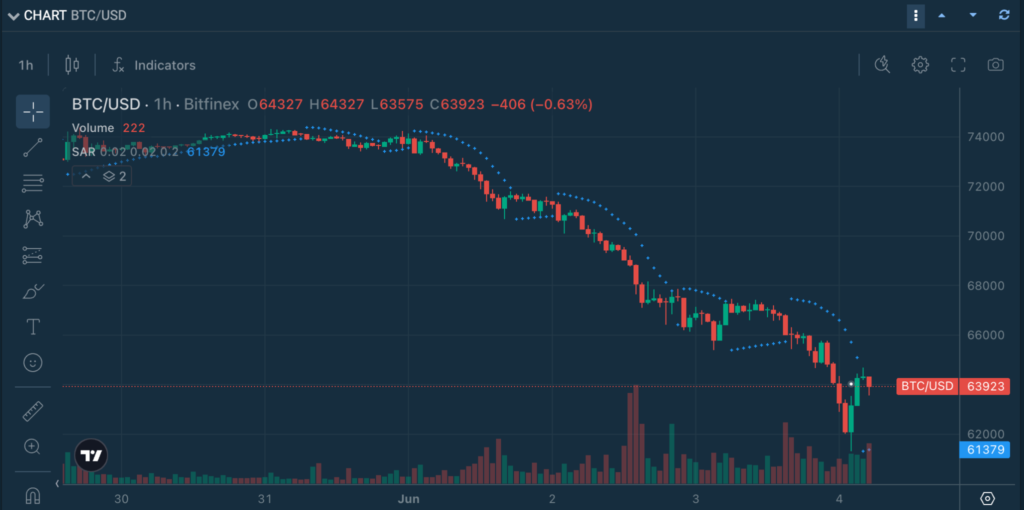
Parabolic SAR was developed by J. Welles Wilder, the same technical analyst behind RSI and ATR. It stands for Parabolic Stop and Reverse. The idea is simple: the indicator helps traders track the direction of a trend and identify where that trend may reverse.
On your chart, Parabolic SAR appears as dots.
- When price is rising, the dots usually appear below the candles
- When price is falling, the dots usually appear above the candles
As long as the dots remain on the same side of price, the trend is considered intact. When price crosses the dots, the indicator flips to the opposite side, signalling that momentum may be shifting.
In an uptrend, a flip above price can suggest buyers are losing control. In a downtrend, a flip below price can indicate that selling pressure is beginning to ease.
How to read Parabolic SAR
Parabolic SAR is one of the easiest indicators to read.
- Price above the dots = bullish momentum
- Price below the dots = bearish momentum
- Dots moving closer to price = trend may be losing strength
- Dots moving further away from price = trend is accelerating
- Dots flipping sides = possible trend reversal
The dots also behave like a dynamic trailing stop.
In a bullish trend, traders often use the dots below price as a level to protect gains. As price rises, the dots rise with it. If price falls below the dots, the trend may be losing control.
In a bearish trend, the dots above price can act as a guide for where selling pressure remains intact. If price breaks above the dots, sellers may be losing control.
Reading the spacing between the dots
The dots do not just tell you the direction of the trend. Their spacing can also reveal how the trend is evolving.
- Dots spreading further apart from each other = momentum is accelerating
- Dots maintaining consistent spacing = trend remains healthy and stable
- Dots clustering closer together = momentum is slowing, trend may be running out of steam
Why does this happen?
Parabolic SAR uses an “acceleration factor” that increases as a trend continues. As momentum builds, the indicator becomes more aggressive and the dots begin moving faster, creating larger gaps between successive dots.
Dot spacing is a momentum clue, not a trading signal by itself. Always combine it with price structure, support and resistance, or indicators like RSI and MACD for confirmation.
Parabolic SAR in action
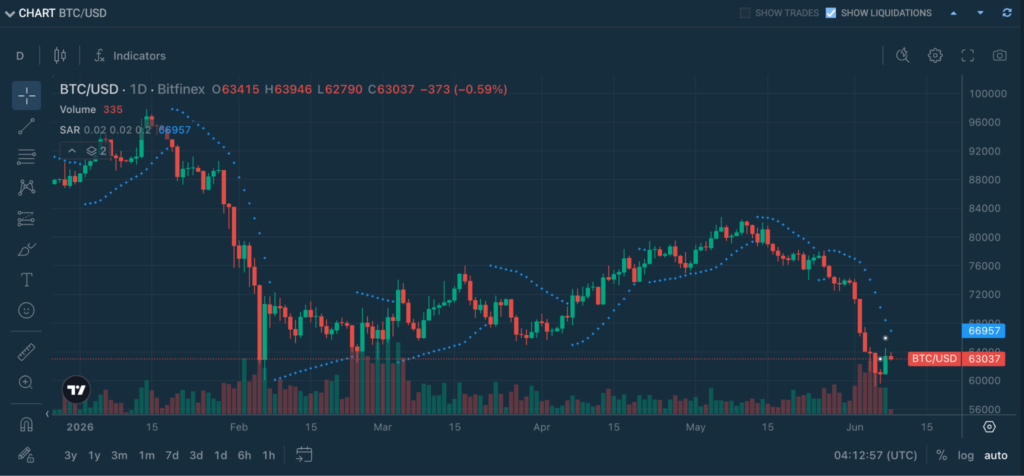
Let’s look at BTC/USD on the daily timeframe on June 8, 2026.
- January – February: SAR shows a clear bearish trend. As the decline accelerated from the $90k area towards the $60k region, the spacing between the dots widened noticeably, signalling that downside momentum was strengthening down the sharp move.
- February – March: BTC began recovering from its lows, but the advance was uneven and choppy. Momentum repeatedly strengthened and weakened, causing Parabolic SAR to generate several flips as the market struggled to establish a clear trend.
- April – Mid May: The clearest signal came in early April when the dots flipped below price as BTC emerged from consolidation near $65,000. Throughout most of the rally that followed, the dots remained below the candles as BTC climbed above $82,000, confirming that buyers remained in control.
- Late May – Early June: The dots flipped back above price as momentum weakened and BTC rolled over from its highs. The distance between the dots and price has widened rapidly following the breakdown showing the bearish momentum accelerating. The sell-off has brought BTC back towards the same $60,000-$61,000 area that acted as support during the February decline. While buyers have since stepped in and triggered a bounce from those lows, the SAR dots remain above price, meaning the indicator has not yet confirmed a bullish reversal.
The key question now is whether bulls can reclaim control. A move back above the SAR level and a fresh bullish flip would suggest buyers are regaining momentum. Until then, Parabolic SAR suggests the short-term trend remains bearish.

Bonus Read: What the 4-Hour Chart Is Telling Us
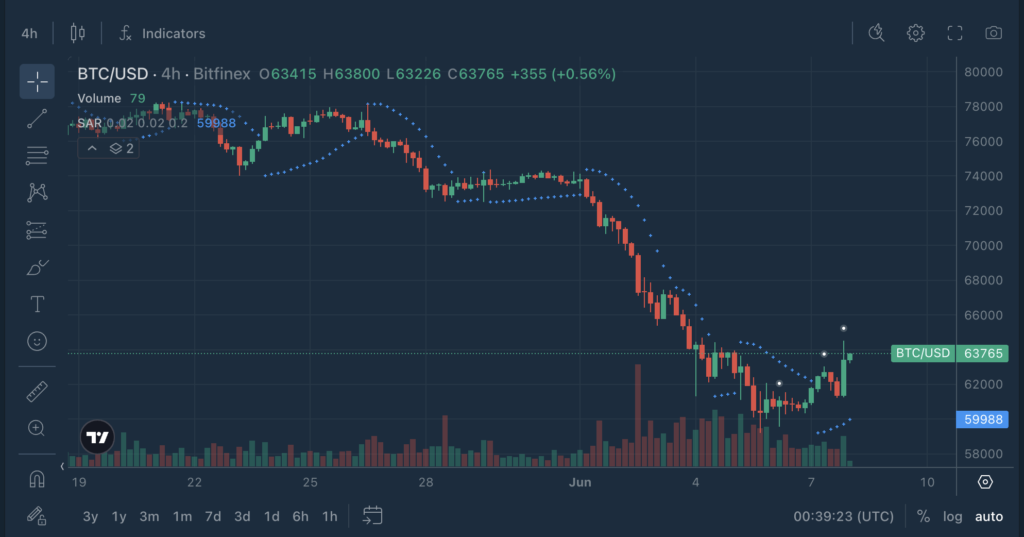
While the daily chart remains under pressure, the 4-hour chart shows the first signs that short-term momentum may be shifting.
Throughout a sharp decline from the $74,000 region toward the $60,000 zone, the Parabolic SAR dots remained firmly above price, confirming that sellers controlled the trend throughout most of the move. During the strongest part of the sell-off, the spacing between the dots widened, reflecting accelerating downside momentum.
As the decline began to slow, however, the dots moved progressively closer to price and to one another. This narrowing gap suggested that bearish momentum was fading, even though the trend remained down.
More recently, the indicator flipped, with the dots moving below price as BTC rebounded from the lows near the $60,000-$61,000 support zone. While a previous bullish flip in early June quickly failed and reverted back to a bearish signal, the latest flip has so far been accompanied by stronger follow-through, with price continuing to push higher and create some distance from the SAR dots. This suggests buyers may be exerting greater control than they did during the previous recovery attempt.
This does not necessarily mean the broader correction is over. Short-term bullish flips can occur within larger downtrends and sometimes fail if buying momentum cannot sustain itself.
While the signal suggests momentum may be shifting, one indicator alone is rarely enough to confirm a lasting trend reversal. What traders will want to see next is stronger price structure, continued support from buyers, and follow-through in the sessions ahead. If it can, the bullish signal may strengthen. If price falls back below the SAR dots and triggers another flip, it would suggest the recent bounce was merely a temporary relief rally.
How to use Parabolic SAR like a pro
Use it in trending markets
Parabolic SAR is built for momentum. Parabolic SAR works best in trending markets. When the price is moving clearly higher or lower, the indicator can help traders stay with the move and avoid exiting too early.
When the price is choppy, the dots can flip above and below. The indicator may flip too often and create false signals.
Use it as a trailing stop
This is one of the cleanest ways to use Parabolic SAR.
- In an uptrend, the dots below price can help you trail your stop higher as the move continues. Instead of guessing where to exit, you let the indicator move with the trend.
- In a downtrend, the dots above price can help you track where bearish momentum remains intact.
Watch the flip, but wait for confirmation
- If the dots flip bullish, look for confirmation from price structure, volume, RSI, MACD, or support levels.
- If the dots flip bearish, check whether price has actually broken structure or is simply reacting inside a range.
Pair it with support and resistance
A SAR flip at a key level matters more.
- For example, if BTC flips bullish near major support, that signal has more weight than a random flip in the middle of a messy range.
- If BTC flips bearish near resistance, it may suggest the market is rejecting that level and momentum is turning lower.
Power combinations
Parabolic SAR + Moving Averages
Moving averages help define the bigger trend. Parabolic SAR helps with timing.
- If price is above the 50-day moving average and SAR flips below price, the bullish signal has more context. The broader trend is already supportive.
- If price is below the 50-day moving average and SAR flips above price, the bearish signal has more weight.
Parabolic SAR + RSI
RSI tells you whether the market is stretched. Parabolic SAR tells you whether momentum is flipping.
- If RSI is recovering from oversold and SAR flips bullish, buyers may be stepping back in.
- If RSI is turning down from overbought and SAR flips bearish, the market may be losing momentum after an extended move.
Parabolic SAR + MACD
MACD helps confirm momentum shifts.
- If SAR flips bullish while MACD is also crossing higher, the reversal has stronger confirmation.
- If SAR flips bearish while MACD is crossing lower, downside momentum may be strengthening.
Parabolic SAR + Support and Resistance
Support and resistance give the signal a location.
- A bullish SAR flip near support can suggest buyers are defending the level.
- A bearish SAR flip near resistance can suggest sellers are stepping in.
This helps traders avoid treating every flip as equal.
Try it on Bitfinex
- Log into Bitfinex
- Choose any trading pair chart
- Add “Parabolic SAR” from the Indicators menu
- Watch whether the dots sit above or below price
- Look for flips near key support, resistance, or trend levels
- Use it alongside RSI, MACD, or moving averages for stronger confirmation
- Leverage Bitfinex’s zero trading fees to implement your strategies with zero trading costs
Bitfinex. Master Your Universe.

Explore the full Chart Decoder library: