


XRP’s recent pullback may have more to do with leverage flushes and broader market weakness than a coordinated exit by large holders, according to CryptoQuant contributor Pelin Ay. The analyst pointed to declining XRP inflows into Binance, particularly among million-token transfers, as evidence that whale selling pressure has not intensified during the drawdown.
Ay shared a CryptoQuant chart tracking XRP Ledger exchange inflows to Binance by value band, alongside XRP’s price in dollar terms. The dataset separates inflows into bands ranging from less than 1,000 XRP to more than 1 million XRP, allowing analysts to distinguish between smaller exchange deposits and transfers more likely associated with whales or institutional-scale wallets.
Related Reading
XRP Whale Selling Pressure Eases As Binance Inflows Drop
According to Ay, the largest transfer cohort has historically played an important role in Binance inflow activity. “Transfers exceeding 1 million XRP are dominant in the chart during certain periods,” she wrote. “This shows that the majority of XRP inflows to Binance are coming from whale and institutional-scale addresses. In particular, the consistently high levels of these inflows between 2021-2025 reveal that major players are actively using Binance.”
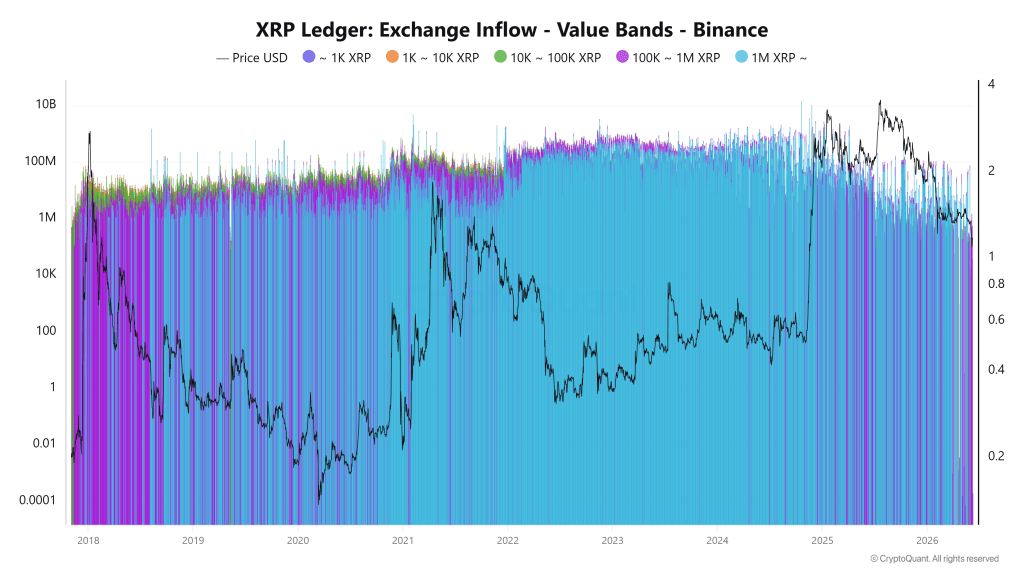
The key shift, in her view, is what happened after XRP’s 2025 peak. The chart shows a visible decline in the largest Binance inflow bands after a period in which XRP approached the $3 area, suggesting that large holders have not been sending tokens to the exchange at the same intensity seen during earlier market phases. In exchange-flow analysis, rising inflows are often interpreted as potential sell-side supply, since assets moved to trading venues can be sold, used as collateral, or repositioned.
Ay argued that the current structure does not resemble prior periods of aggressive distribution. “In the past, before major drops, there were usually sudden high spikes in the 100K–1M XRP and 1M+ XRP groups. Currently, at the end of the chart, there is no such extraordinary inflow surge. Therefore, on-chain data currently reduces the likelihood of aggressive whale selling and mass profit-taking.”
That distinction is central to her thesis. If XRP were undergoing a classic whale-led sell-off, the chart would be expected to show a sharp increase in large deposits to Binance, especially from the 100,000-to-1-million XRP and 1-million-plus XRP bands. Instead, Ay says the opposite is visible: inflows have cooled while price has weakened.
Related Reading
“The chart suggests that the decline is largely due to leverage liquidations and overall market weakness,” she added. “Because in normal hard bear markets, much higher XRP inflows to exchanges are typically seen.”
The implication is not that XRP has no downside risk. Rather, Ay’s reading is that the current sell-off lacks one of the more damaging on-chain signatures often associated with deeper capitulation: whales sending unusually large amounts of XRP to exchanges. That makes the source of selling pressure important. A liquidation-driven move can accelerate quickly when leveraged positions are forced out, but it does not necessarily imply that long-term holders are actively distributing into the market.
Ay also linked the post-peak reduction in inflows to weakening spot supply pressure. “If Binance inflows continue to remain low, selling supply will decrease,” she wrote. “With an increase in demand, it becomes easier for XRP to move back to the $1.8-2.0 region. Especially if sharp rises do not resume in the 1M+ XRP columns, this structure can be maintained.”
The condition matters. Her argument depends on large Binance inflows remaining muted, particularly in the 1-million-plus XRP band. A renewed spike in those columns would weaken the analysis, as it would suggest that large wallets are once again moving meaningful supply toward the exchange.
At press time, XRP traded at $1.1444.
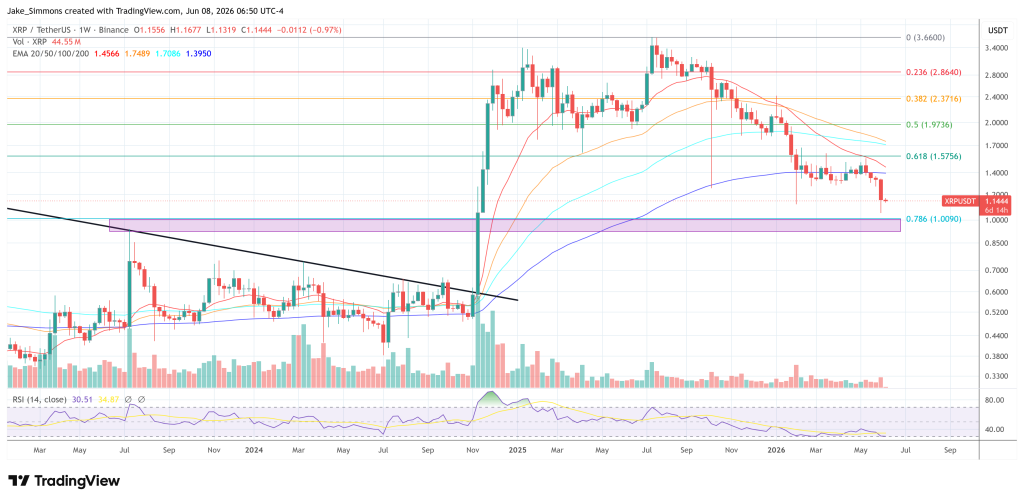
Featured image created with DALL.E, chart from TradingView.com