

“A 24‑hour blackout would honestly feel like losing a limb for most people on a desk,” says Tom Banfield, Head of Financial Derivatives at institutional broker Britannia Global Markets.
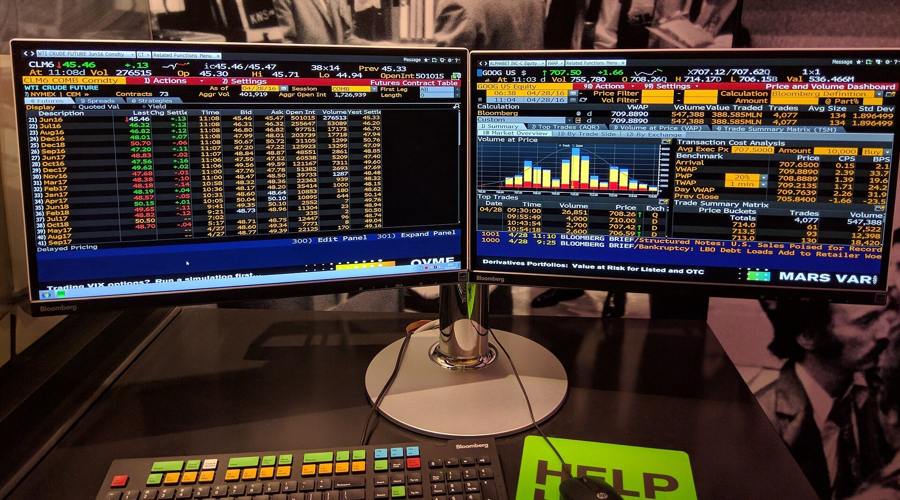
This is the peculiar, symbiotic reality of the financial professional with the Bloomberg Terminal. To the casual observer, the Terminal might look like a clunky, expensive relic of the 1980s, its glowing, monospaced setup looking more like a prop from the techno-thriller WarGames than a cutting-edge piece of fintech.
Yet, for those in the know, the Terminal is not merely a tool; it is a prosthetic.
Michael Bloomberg’s retro monolith has been a constant in financial markets over the last three decades. Its relationship with trading desks and analysts is defined by dependency and underpinned by a level of trust that few other technologies have ever managed to cultivate.
Naturally, the Terminal’s universal appeal has spawned many challengers.
The AI Challenger Emerges
There have been multi-billion-dollar corporate competitors that promised better interfaces and cleaner data; the Terminal survived them all. There was the 2008 financial bloodbath, which saw the disappearance of many of the very desks that hosted these machines; the Terminal rebounded a year later.
Even when Wall Street heavyweights attempted to abstract away its functions through internal systems, the Terminal responded, adapted, and retained the throne.
The arrival of the latest wave of artificial intelligence has, predictably, sparked a new chorus of opinions regarding the Terminal’s demise.
The launch of Perplexity’s Computer in February captured the attention of almost everyone with even a glancing interest in AI. Naturally, the tech-utopians were quick to put it to the test.
One particularly vocal user on X, known as Hampton, claimed to have needed but one afternoon to build a clone of Bloomberg’s Terminal on Perplexity.
His declaration was as bold as it was premature: “Perplexity just became the first AI company to truly go head-to-head with the Bloomberg Terminal.
Hampton shared a short clip of his terminal clone in operation. On the surface, it was an impressive feat. It managed to replicate basic information feeds and rudimentary charts with the sort of speed that makes Silicon Valley reach for its chequebooks.
Perplexity just became the the first Al company to truly go head-to-head with the Bloomberg Terminal…
Using Perplexity Computer (with no local setup or single LLM limitation), it was able to build me a terminal with real-time data to analyze $NVDA using Perplexity Finance: pic.twitter.com/S3l5F5MRiv
— ₕₐₘₚₜₒₙ (@hamptonism) February 25, 2026
The fact that the AI challengers are far, far cheaper than the Terminal is no longer the whole pitch.
They use chat and natural-language queries so users can get answers, summaries, or model outputs instantly instead of navigating dense terminal commands. Where the Terminal demands that the user speak its peculiar, staccato language, the AI challengers offer to speak the user’s. Indeed, the core introductory Bloomberg course is about 8 hours, while a broader set of beginner certificate modules can run closer to 16 hours.
That is one steep learning curve.
Built‑in LLMs can also summarise earnings calls, generate investment theses, and extract signals from filings or transcripts in seconds. There is also a case to be made about the interface: they are not a one-size-fits-all. While the Terminal offers the same imposing dashboard to every user, AI allows for a more bespoke experience that can be tailored to the specific niche of a quantitative analyst or a retail broker.
But to beat Michael Bloomberg’s brainchild, price, feeds, and personalisation might not be enough, as a long line of better-funded challengers has already discovered.
At What Cost?
The most common complaint lodged against the Terminal is, and always has been, the price; the always, infuriatingly high price. The Terminal costs around $30,000 per year for a single seat. In a world where software-as-a-service (SaaS) prices have been driven down by relentless competition, and with AI now threatening to eclipse even those prices, that figure feels almost antiquated.
It remains Bloomberg’s bread-and-butter, accounting in some years for up to 90% of the company’s revenue.
For some, the cost has become a bridge too far.
The Risk Desk at CFD and FX broker Trade Nation, for instance, relied on the Terminal for a decade. However, a recent shift in the charging structure prompted a rethink. “For the past couple of years, the Desk has used Refinitiv (a competitor), which meets their requirements whilst remaining competitive from a price point,” a spokesperson from the broker says.
Michał Stajniak, Deputy Director of the Research Department, XTB.
They are not alone in their discontent. Jamie Dimon, the CEO of JPMorgan Chase & Co., shared similar concerns in 2017. He complained in a letter to shareholders that his bank paid around US$9 billion on tech services in 2016, a sum roughly equivalent to a fifth of the gross domestic product of Cyprus.
For many financial services firms, information technology is the single largest expense after personnel.
Yet, for a significant portion of the market, the Terminal’s exorbitant price is not just a cost; it is a premium paid for clarity.
Michał Stajniak, Deputy Director of the Research Department at Poland-based retail broker XTB, concedes that while the Terminal is expensive, “the way it presents and aggregates data, combined with the quality of its insights, justifies even that very high price tag.”
For others, the Terminal pays for itself through sheer efficiency. Banfield argues that “the productivity, connective and overall output easily justifies the expense. In modern broking, especially, having everything you need at your fingertips is something I genuinely couldn’t do without.”
What the challengers, AI or otherwise, consistently fail to grasp is the depth to which the Terminal is entrenched in the lives of its users.
Some have even been known to order their wedding cakes in the shape of the Terminal, a level of brand loyalty that would make Apple’s marketing department green with envy.
The Terminal Maketh the Trader
For most, the day does not begin with reading emails or checking the weather; it begins with the Terminal. It is the first thing users check in the morning, whether they are opening Instant Bloomberg (IB) chats or scrolling through overnight headlines to gauge market-moving stories.
For Banfield, the ritual begins on the commute. “It’s a simple habit, but a crucial one,” he says. If, as the old proverb suggests, habits maketh the man, then the Terminal maketh the trader.
Daniel Aristidou, Quantitative Research Team Leader at Exness, one of the world’s largest retail brokers, highlights the specific functions that anchor this loyalty. “I usually start with TOP
This command, one of the thousands of shorthand codes that users must memorise, is a symbol of the Terminal’s true value: separating signal from noise.
The Gravitational Pull of Network Effects
While AI challengers like Perplexity Computer or smaller outfits like Fincept can replicate charts and data feeds, they struggle to replace the Terminal’s social architecture: the IB Chat.
Consider the case of Symphony. Launched in 2014 by a consortium of heavyweights including JPMorgan Chase, Goldman Sachs, and BlackRock, with Google even chipping in a cool US$233 million, Symphony was a “Bloomberg killer” that had the muscle to do the deed.
It promised a communications infrastructure with better encryption and more transparency for a fraction of the cost: just US$15 a month.
Bloomberg’s response was a masterclass in defensive positioning. It simply unbundled its chat service, creating a standalone offering for US$10 a month. In a race to the bottom on price, the incumbent held its ground.
As Banfield puts it, “The real appeal or maybe even the gravitational pull of a terminal is the network effect behind it. With clients, counterparties, and firms all using the same platform, it’s become a core part of modern broking floors.”
Daniel Aristidou, Quantitative Research Team Leader, Exness.
Beyond the chat, there is the matter of vetting. Stajniak points out that even when a piece of news remains unconfirmed, Bloomberg’s commentary will explicitly state as much. This process of curation and verification sets it apart from the wild west of the open internet.
Aristidou also points to the support system, a 24/7 direct link to knowledgeable analysts. In the high-velocity world of market volatility, he stresses, that matters far more than people assume.
“Speaking from personal experience, what keeps Bloomberg relevant is that it’s not just a tool; it’s an ecosystem,” says Aristidou. “The market is there. The people are there. A lot of interaction happens inside that environment throughout the day, and that matters more than people think. No one’s been able to reproduce the same level of support, documentation, stability, and integrated tooling.”
Replicating the Terminal is Out of The Question
Life without the Terminal would not grind to a halt, as most serious firms have redundancies, but it would certainly lose its lustre. Aristidou notes that without it, workflows would be plagued by friction. “You’re suddenly stitching together information from multiple systems, which adds friction; in fast markets, even a small delay in understanding what is happening can matter.”
Stajniak echoes this sentiment. While analysts can rely on alternative data sources, for traders, the Terminal is “indispensable.” Bloomberg employs hundreds of people to curate data and write reports, a human infrastructure that an afternoon of vibe coding cannot replicate. “While it’s possible to build your own proprietary systems for a small niche or a specific market segment, building a tool with the sheer breadth and scope of Bloomberg is out of the question,” he stresses.
Banfield concurs, noting that even after 44 years, the Terminal remains the benchmark. On almost any desk of consequence, you will find at least one.
So, What About the New AI Challengers?
The consensus on AI is one of cautious utility rather than existential dread. Finetuned dashboards and custom models have been around long before the current AI revolution.
Stajniak notes that while the pace of AI updates is dizzying, Bloomberg’s greatest asset is its reliability. It is dependable, especially when the market decides to lose its mind.
Aristidou acknowledges that Large Language Models (LLMs) are “genuinely useful” for speeding up workflows or prototyping ideas. However, he makes a sharp distinction between a supporting tool and core infrastructure. Once accuracy, validation and reproducibility become the metrics of success, LLMs often fall short.
Tom Banfield, Head of Financial Derivatives, Britannia Global Markets.
They remain unpredictable, occasionally modifying unrelated code or producing outputs that are “convincing but need verification.”
In a world where a misplaced decimal point can trigger a multi-million-euro loss, ‘convincing but wrong’ is a fireable offence. His team at Exness builds custom tools for specific calculations, but they view AI as a supplement rather than a replacement. The focus must remain on robust, testable systems.
Banfield is even more direct: “We haven’t attempted to nor intend to replace the terminal with an equivalent LLM‑driven dashboard. Yes, absolutely, tools like Claude and ChatGPT are impressive. However, I feel they serve more of a complementary role rather than a substitute for a terminal like Bloomberg.”
At the end of the day, the Bloomberg Terminal has survived because it is more than the sum of its data points. It is a social club, a security blanket and a common language. It is a monument to the fact that in the world of high finance, information is only as good as the speed at which it can be acted upon and the trust you have in the person, or the machine, providing it.
AI has yet to learn how to be the limb the market refuses to live without.
“A 24‑hour blackout would honestly feel like losing a limb for most people on a desk,” says Tom Banfield, Head of Financial Derivatives at institutional broker Britannia Global Markets.
This is the peculiar, symbiotic reality of the financial professional with the Bloomberg Terminal. To the casual observer, the Terminal might look like a clunky, expensive relic of the 1980s, its glowing, monospaced setup looking more like a prop from the techno-thriller WarGames than a cutting-edge piece of fintech.
Yet, for those in the know, the Terminal is not merely a tool; it is a prosthetic.
Michael Bloomberg’s retro monolith has been a constant in financial markets over the last three decades. Its relationship with trading desks and analysts is defined by dependency and underpinned by a level of trust that few other technologies have ever managed to cultivate.
Naturally, the Terminal’s universal appeal has spawned many challengers.
The AI Challenger Emerges
There have been multi-billion-dollar corporate competitors that promised better interfaces and cleaner data; the Terminal survived them all. There was the 2008 financial bloodbath, which saw the disappearance of many of the very desks that hosted these machines; the Terminal rebounded a year later.
Even when Wall Street heavyweights attempted to abstract away its functions through internal systems, the Terminal responded, adapted, and retained the throne.
The arrival of the latest wave of artificial intelligence has, predictably, sparked a new chorus of opinions regarding the Terminal’s demise.
The launch of Perplexity’s Computer in February captured the attention of almost everyone with even a glancing interest in AI. Naturally, the tech-utopians were quick to put it to the test.
One particularly vocal user on X, known as Hampton, claimed to have needed but one afternoon to build a clone of Bloomberg’s Terminal on Perplexity.
His declaration was as bold as it was premature: “Perplexity just became the first AI company to truly go head-to-head with the Bloomberg Terminal.
Hampton shared a short clip of his terminal clone in operation. On the surface, it was an impressive feat. It managed to replicate basic information feeds and rudimentary charts with the sort of speed that makes Silicon Valley reach for its chequebooks.
Perplexity just became the the first Al company to truly go head-to-head with the Bloomberg Terminal…
Using Perplexity Computer (with no local setup or single LLM limitation), it was able to build me a terminal with real-time data to analyze $NVDA using Perplexity Finance: pic.twitter.com/S3l5F5MRiv
— ₕₐₘₚₜₒₙ (@hamptonism) February 25, 2026
The fact that the AI challengers are far, far cheaper than the Terminal is no longer the whole pitch.
They use chat and natural-language queries so users can get answers, summaries, or model outputs instantly instead of navigating dense terminal commands. Where the Terminal demands that the user speak its peculiar, staccato language, the AI challengers offer to speak the user’s. Indeed, the core introductory Bloomberg course is about 8 hours, while a broader set of beginner certificate modules can run closer to 16 hours.
That is one steep learning curve.
Built‑in LLMs can also summarise earnings calls, generate investment theses, and extract signals from filings or transcripts in seconds. There is also a case to be made about the interface: they are not a one-size-fits-all. While the Terminal offers the same imposing dashboard to every user, AI allows for a more bespoke experience that can be tailored to the specific niche of a quantitative analyst or a retail broker.
But to beat Michael Bloomberg’s brainchild, price, feeds, and personalisation might not be enough, as a long line of better-funded challengers has already discovered.
At What Cost?
The most common complaint lodged against the Terminal is, and always has been, the price; the always, infuriatingly high price. The Terminal costs around $30,000 per year for a single seat. In a world where software-as-a-service (SaaS) prices have been driven down by relentless competition, and with AI now threatening to eclipse even those prices, that figure feels almost antiquated.
It remains Bloomberg’s bread-and-butter, accounting in some years for up to 90% of the company’s revenue.
For some, the cost has become a bridge too far.
The Risk Desk at CFD and FX broker Trade Nation, for instance, relied on the Terminal for a decade. However, a recent shift in the charging structure prompted a rethink. “For the past couple of years, the Desk has used Refinitiv (a competitor), which meets their requirements whilst remaining competitive from a price point,” a spokesperson from the broker says.
Michał Stajniak, Deputy Director of the Research Department, XTB.
They are not alone in their discontent. Jamie Dimon, the CEO of JPMorgan Chase & Co., shared similar concerns in 2017. He complained in a letter to shareholders that his bank paid around US$9 billion on tech services in 2016, a sum roughly equivalent to a fifth of the gross domestic product of Cyprus.
For many financial services firms, information technology is the single largest expense after personnel.
Yet, for a significant portion of the market, the Terminal’s exorbitant price is not just a cost; it is a premium paid for clarity.
Michał Stajniak, Deputy Director of the Research Department at Poland-based retail broker XTB, concedes that while the Terminal is expensive, “the way it presents and aggregates data, combined with the quality of its insights, justifies even that very high price tag.”
For others, the Terminal pays for itself through sheer efficiency. Banfield argues that “the productivity, connective and overall output easily justifies the expense. In modern broking, especially, having everything you need at your fingertips is something I genuinely couldn’t do without.”
What the challengers, AI or otherwise, consistently fail to grasp is the depth to which the Terminal is entrenched in the lives of its users.
Some have even been known to order their wedding cakes in the shape of the Terminal, a level of brand loyalty that would make Apple’s marketing department green with envy.
The Terminal Maketh the Trader
For most, the day does not begin with reading emails or checking the weather; it begins with the Terminal. It is the first thing users check in the morning, whether they are opening Instant Bloomberg (IB) chats or scrolling through overnight headlines to gauge market-moving stories.
For Banfield, the ritual begins on the commute. “It’s a simple habit, but a crucial one,” he says. If, as the old proverb suggests, habits maketh the man, then the Terminal maketh the trader.
Daniel Aristidou, Quantitative Research Team Leader at Exness, one of the world’s largest retail brokers, highlights the specific functions that anchor this loyalty. “I usually start with TOP
This command, one of the thousands of shorthand codes that users must memorise, is a symbol of the Terminal’s true value: separating signal from noise.
The Gravitational Pull of Network Effects
While AI challengers like Perplexity Computer or smaller outfits like Fincept can replicate charts and data feeds, they struggle to replace the Terminal’s social architecture: the IB Chat.
Consider the case of Symphony. Launched in 2014 by a consortium of heavyweights including JPMorgan Chase, Goldman Sachs, and BlackRock, with Google even chipping in a cool US$233 million, Symphony was a “Bloomberg killer” that had the muscle to do the deed.
It promised a communications infrastructure with better encryption and more transparency for a fraction of the cost: just US$15 a month.
Bloomberg’s response was a masterclass in defensive positioning. It simply unbundled its chat service, creating a standalone offering for US$10 a month. In a race to the bottom on price, the incumbent held its ground.
As Banfield puts it, “The real appeal or maybe even the gravitational pull of a terminal is the network effect behind it. With clients, counterparties, and firms all using the same platform, it’s become a core part of modern broking floors.”
Daniel Aristidou, Quantitative Research Team Leader, Exness.
Beyond the chat, there is the matter of vetting. Stajniak points out that even when a piece of news remains unconfirmed, Bloomberg’s commentary will explicitly state as much. This process of curation and verification sets it apart from the wild west of the open internet.
Aristidou also points to the support system, a 24/7 direct link to knowledgeable analysts. In the high-velocity world of market volatility, he stresses, that matters far more than people assume.
“Speaking from personal experience, what keeps Bloomberg relevant is that it’s not just a tool; it’s an ecosystem,” says Aristidou. “The market is there. The people are there. A lot of interaction happens inside that environment throughout the day, and that matters more than people think. No one’s been able to reproduce the same level of support, documentation, stability, and integrated tooling.”
Replicating the Terminal is Out of The Question
Life without the Terminal would not grind to a halt, as most serious firms have redundancies, but it would certainly lose its lustre. Aristidou notes that without it, workflows would be plagued by friction. “You’re suddenly stitching together information from multiple systems, which adds friction; in fast markets, even a small delay in understanding what is happening can matter.”
Stajniak echoes this sentiment. While analysts can rely on alternative data sources, for traders, the Terminal is “indispensable.” Bloomberg employs hundreds of people to curate data and write reports, a human infrastructure that an afternoon of vibe coding cannot replicate. “While it’s possible to build your own proprietary systems for a small niche or a specific market segment, building a tool with the sheer breadth and scope of Bloomberg is out of the question,” he stresses.
Banfield concurs, noting that even after 44 years, the Terminal remains the benchmark. On almost any desk of consequence, you will find at least one.
So, What About the New AI Challengers?
The consensus on AI is one of cautious utility rather than existential dread. Finetuned dashboards and custom models have been around long before the current AI revolution.
Stajniak notes that while the pace of AI updates is dizzying, Bloomberg’s greatest asset is its reliability. It is dependable, especially when the market decides to lose its mind.
Aristidou acknowledges that Large Language Models (LLMs) are “genuinely useful” for speeding up workflows or prototyping ideas. However, he makes a sharp distinction between a supporting tool and core infrastructure. Once accuracy, validation and reproducibility become the metrics of success, LLMs often fall short.
Tom Banfield, Head of Financial Derivatives, Britannia Global Markets.
They remain unpredictable, occasionally modifying unrelated code or producing outputs that are “convincing but need verification.”
In a world where a misplaced decimal point can trigger a multi-million-euro loss, ‘convincing but wrong’ is a fireable offence. His team at Exness builds custom tools for specific calculations, but they view AI as a supplement rather than a replacement. The focus must remain on robust, testable systems.
Banfield is even more direct: “We haven’t attempted to nor intend to replace the terminal with an equivalent LLM‑driven dashboard. Yes, absolutely, tools like Claude and ChatGPT are impressive. However, I feel they serve more of a complementary role rather than a substitute for a terminal like Bloomberg.”
At the end of the day, the Bloomberg Terminal has survived because it is more than the sum of its data points. It is a social club, a security blanket and a common language. It is a monument to the fact that in the world of high finance, information is only as good as the speed at which it can be acted upon and the trust you have in the person, or the machine, providing it.
AI has yet to learn how to be the limb the market refuses to live without.