


I’ve been watching Fitbit dissolve into Google’s product ecosystem for years, and I’ll be honest, I’d kind of written it off. Then Google dropped the Fitbit Air last night—a screen-free tracker aimed squarely at the WHOOP crowd—and I immediately had to rethink my past assumptions.
Here’s what I didn’t see coming: this thing has AFib detection. On a $99.99 tracker. WHOOP only offers that on the WHOOP MG, which requires a $359/year subscription. Google just slipped a premium health feature into an entry-level device. That move alone reshapes the whole Google Fitbit Air vs WHOOP 5.0 conversation.
The WHOOP 5.0 is still excellent. It’s the tracker that serious athletes and biohacker types have been reaching for, for the past year. But it costs as much as a gym membership just to use. The Fitbit Air comes in at $99.99 upfront with an optional subscription, and it’s packing more than anyone expected.
So is Google actually onto something here, or does WHOOP still hold the crown? Let’s get into it.
Fitbit Air vs WHOOP 5.0: Quick Verdict
Short answer: Fitbit Air if you want serious everyday health tracking—including AFib monitoring—without a subscription. WHOOP 5.0 if you’re a dedicated athlete who needs recovery data and can justify the cost.

Fitbit Air and WHOOP 5.0: Head-to-Head Breakdown
Fitbit Air vs WHOOP 5.0: Price & Total Cost of Ownership
This is where the conversation starts—and where it almost ends.
The Fitbit Air is $99.99 upfront, and it comes with a three-month trial of Google Health Premium. So you get full access to Google Health Coach from day one at no extra cost. After the trial, Google Health Premium runs $9.99/month or $99/year. Core tracking features work without the subscription; the Premium layer is mainly what unlocks AI coaching. So worst case, you’re looking at ~$199 in the first year. Then it’s $99/year to maintain it. One more thing worth knowing: if you’re already a Google AI Pro or Ultra subscriber, Google Health Premium is included at no extra charge.
WHOOP 5.0 operates on a fundamentally different model: there’s no upfront hardware cost, but you’re locked into $199/year for the entry-level WHOOP One tier, which includes the 5.0 device. If you want the Whoop MG hardware — with FDA-cleared ECG and AFib detection — that’s $359/year on the Life tier. There’s no free tier, no trial, no opting out of the subscription — the device doesn’t work without it.
Verdict: Fitbit Air wins on cost. Even with Google Health Premium, you’re spending much less than a basic WHOOP membership annually—and significantly less than the Whoop MG tier. Over three years, that gap compounds fast.
Fitbit Air vs WHOOP 5.0: Health Tracking Depth
This is where things get interesting, because the Fitbit Air came in swinging harder than anyone expected.
Fitbit Air—tracks 24/7 heart rate, heart rhythm monitoring with AFib alerts, SpO2, resting heart rate, HRV, and sleep stages and duration. The AFib alert feature is the headline here—and it’s part of the free tier, no subscription required. One important nuance, though: the Fitbit Air uses optical heart rate sensing (PPG-based) to passively monitor heart rhythm, not an ECG. The WHOOP MG’s AFib detection is on-demand ECG, which is more precise and clinically reliable. Both can flag irregular rhythms, but they’re not quite equivalent.
That said, getting passive optical AFib monitoring at no extra cost, on a $99.99 device, when WHOOP charges $359/year for any AFib detection at all, is still a significant win for most everyday users. Beyond passive tracking, the Google Health Coach can use your sleep data, HR trends, activity history, and even photos of your gym equipment to generate personalized guidance. Plus, the automatic workout detection gets smarter and more personalized over time.
WHOOP 5.0 captures biometric data 26 times per second using upgraded sensors, tracking HRV, sleep stages, strain, recovery, stress, blood oxygen, skin temperature, and VO2 Max across 145+ supported activities. Its sleep staging algorithm was trained on polysomnography data from clinical partners. It’s better at detecting light, REM, and deep sleep compared to its predecessor. It also tracks WHOOP Age (a longevity metric) and Women’s Hormonal Insights across all tiers. The Whoop MG adds on-demand ECG with FDA clearance for AFib.
Verdict: WHOOP 5.0 still goes deeper on athletic recovery — VO2 Max, strain scores, and clinical-grade sleep staging are hard to beat. But the Fitbit Air closes the AFib gap for a fraction of the price is a genuine upset. For everyday health awareness, the Fitbit Air is no longer playing in a lower league.
Fitbit Air vs WHOOP 5.0: Battery Life

This matters more than most people admit, especially for screen-free trackers that are supposed to stay on your wrist 24/7.
WHOOP 5.0 delivers 14+ days of battery life and supports on-the-wrist charging, so you never really have to stop tracking.
Fitbit Air clocks in at up to 7 days—exactly half. But Google’s answer to that is a fast-charge feature: just 5 minutes of charging gives you a full day of power. You’ll take it off more often than a WHOOP wearer, but you’ll never be in a situation where you’re dead for hours waiting on a charge.
Verdict: WHOOP wins on raw battery life, no contest. The Fitbit Air’s fast-charge partly compensates, but if your whole thing is uninterrupted 24/7 data collection, Whoop is the safer bet.
Fitbit Air vs WHOOP 5.0: Design & Comfort
Both trackers are screen-free, which means they’re both offering comfortable, distraction-free wear— but they go about it differently.
WHOOP 5.0 is 7% smaller than its predecessor, with an IP68 rating (water-resistant up to 10 meters for 2 hours) and a clasp-style band system designed for athletic wear. It looks like a serious athlete’s tracker, because it is.
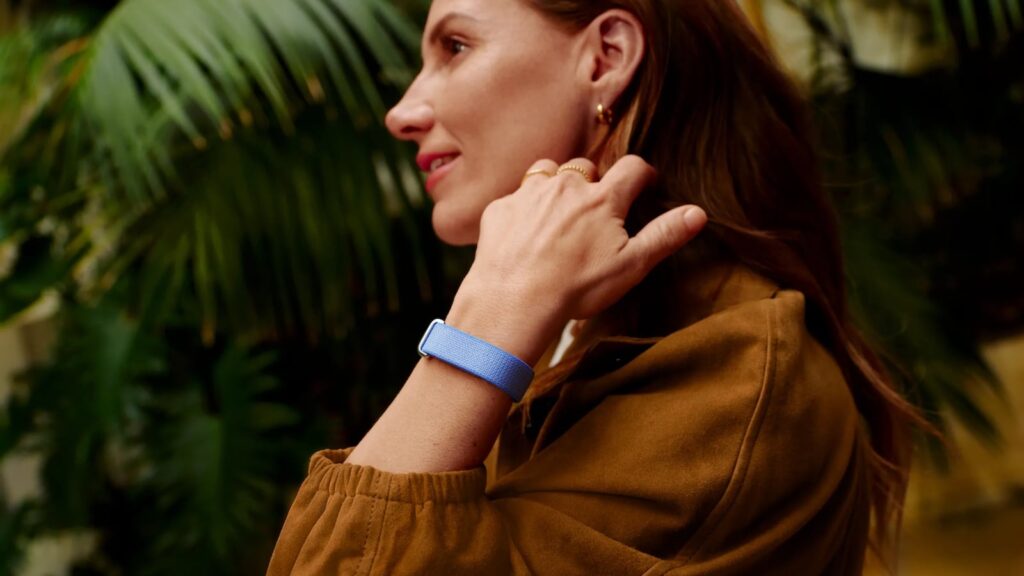
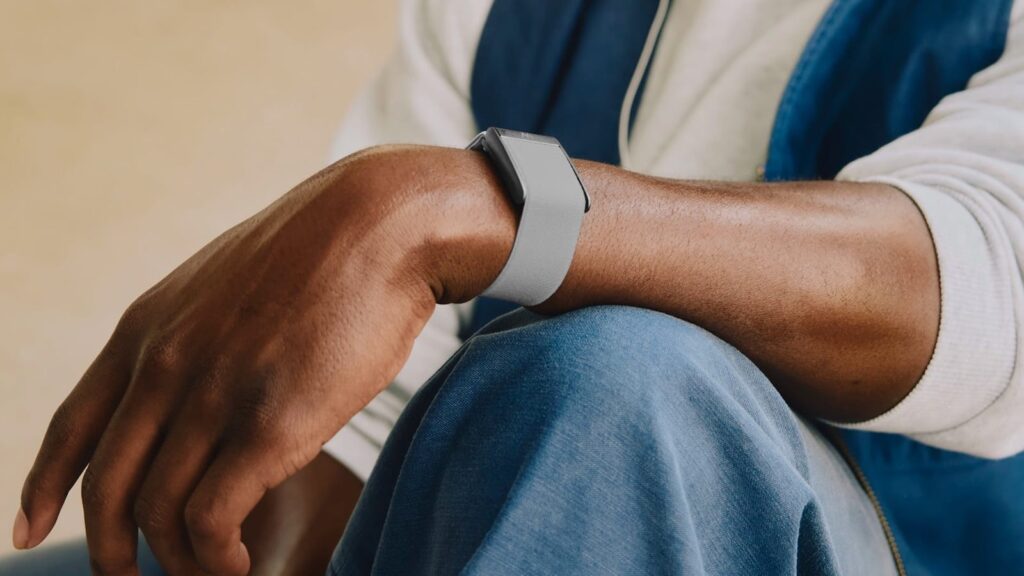
Fitbit Air, on the other hand, is built around a tiny, discreet “pebble” sensor module—Google’s words—that pops in and out of interchangeable bands. It’s their smallest tracker ever, and the strap lineup actually has range: the Performance Loop (recycled materials, micro-adjustable, breathable — included in the box) comes in Fog, Obsidian, Lavender, and Berry. The Active Band is sweatproof silicone for training. The Elevated Modern Band is the lifestyle play — designed to look like a bracelet instead of a fitness tracker. There’s also a Stephen Curry Special Edition Performance Loop in rye brown and game-day orange, with a water-resistant coating and raised interior print for airflow—available May 26 for $129.99. Accessory bands start at $34.99.
Verdict: Fitbit Air wins for wear and versatility. The Elevated Modern Band is the kind of move WHOOP has never really made, but is oh-so-important if you actually plan on wearing a tracker, like, out to dinner or a work event.
Fitbit Air vs WHOOP 5.0:App & AI Experience
The app is where all that sensor data either becomes useful or just noise.
WHOOP 5.0‘s app is mature, deep, and community-beloved. The coaching insights are built around HRV, strain, and recovery scores—and they’re backed by years of population data and continuous platform improvements. It really is one of the best health platforms in the consumer wearable space.
Fitbit Air launches alongside the full rebrand from Fitbit app to Google Health, complete with a new heart-shaped logo in Google’s colors and a new premium tier called Google Health Premium. The centerpiece is Google Health Coach—a Gemini-powered AI assistant that synthesizes your sleep, HR, activity, and even meal photos into personalized recommendations.
Google Health Coach officially launches May 19. The Fitbit app migration to Google Health is also rolling out this month. The Fitbit Air is also compatible with both Android and iOS, and Google confirmed you can pair it with a Pixel Watch—without missing data.
Verdict: WHOOP’s app wins today on depth and proven track record. But Google Health Coach is the most ambitious AI health play from any major wearable right now. The three-month trial bundled with the Fitbit Air means you’ll have enough real time to judge it for yourself before deciding whether the $99/year Premium subscription is worth continuing.
Fitbit Air and WHOOP 5.0: Who They’re Actually For
WHOOP 5.0: Endurance athletes, CrossFitters, cyclists, serious gym-goers, and anyone whose identity is partially built around recovery optimization. People who track HRV before deciding whether to go hard at the gym. Biohackers. The kind of person who has opinions about sleep stages, WHOOP 5.0 is perfect for all of ’em.
Fitbit Air: For health-conscious everyday people who want passive, intelligent tracking without a screen distracting them or a subscription demanding their paycheck. People who used to love Fitbit but drifted away. Anyone on Android or iOS already in the Google ecosystem. People who want AFib monitoring without paying $359/year, Fitbit Air is your device.
Where Fitbit Air Wins
With Fitbit Air, cost is the obvious win, but the AFib tracking matters. Getting passive AFib monitoring on a $99.99 device—free, no subscription—when WHOOP charges $359/year for ECG-based AFib detection, is a true value. Sure, Whoop MG’s on-demand ECG is more clinically precise. But for most people, optical AFib alerts are more than enough to flag something worth checking with a doctor—which you’ll do with the MG, too. Add the three-month Google Health Premium trial, the Gemini coaching potential, and a band lineup that actually has lifestyle options, and Google has built something with very wide appeal—almost like the original Fitbit.
Where WHOOP 5.0 Wins
If you’re training with intent, WHOOP 5.0 is still the one. The depth of biometric tracking—26x-per-second data capture, sleep staging, VO2 Max, WHOOP Age—is platform maturity that a brand-new Google AI coach will have to earn over years. The 14+ day battery with on-the-wrist charging allows truly uninterrupted data collection. And the WHOOP community speaks directly to serious athletes in a way that a Gemini-powered wellness coach doesn’t quite replicate yet. If recovery data literally changes your training decisions every day, WHOOP’s subscription cost justifies itself.
Final Verdict
For most people comparing these two, the Fitbit Air is the better buy—and it’s closer to a clean win than I anticipated going in. Google built a cheaper WHOOP alternative, on a device with premium features. There’s Gemini AI coaching and a three-month Premium trial for $99.99 upfront. That’s a serious value proposition.
WHOOP 5.0 still wins for serious athletes who need the deepest recovery data available and can justify the subscription costs. But for everyone else, from the health-curious to the budget-conscious, Google just made a very compelling case for Fitbit. I can already see the Fitbit Air landing on my list of the best fitness trackers for women this year.
The post Fitbit Air vs WHOOP 5.0: Fitbit just made me question my WHOOP subscription appeared first on Gadget Flow.