

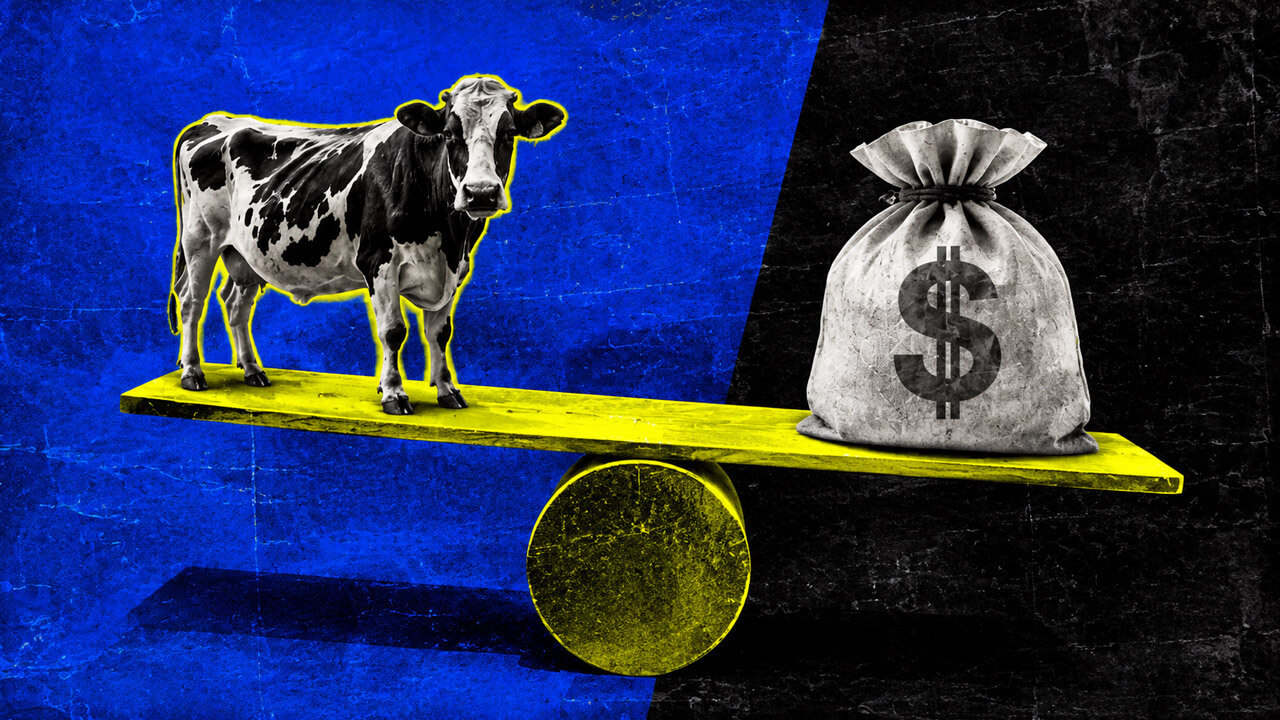
Ten dairy cows in Paraná, Brazil, carried encrypted identities that Cowmed collars had built from each animal’s health, behavior, and location data into B3 this week.
Those identities turned the cows into collateral for nearly $20,000 in credit, and the record behind them aims to shrink the haircut lenders apply and stop lenders from pledging the same animal twice.
Brazil’s pilot proves the mechanics work at a small scale, and the bigger opportunity sits in countries where farmers own valuable livestock and cannot borrow against it because they lack the land titles banks require.
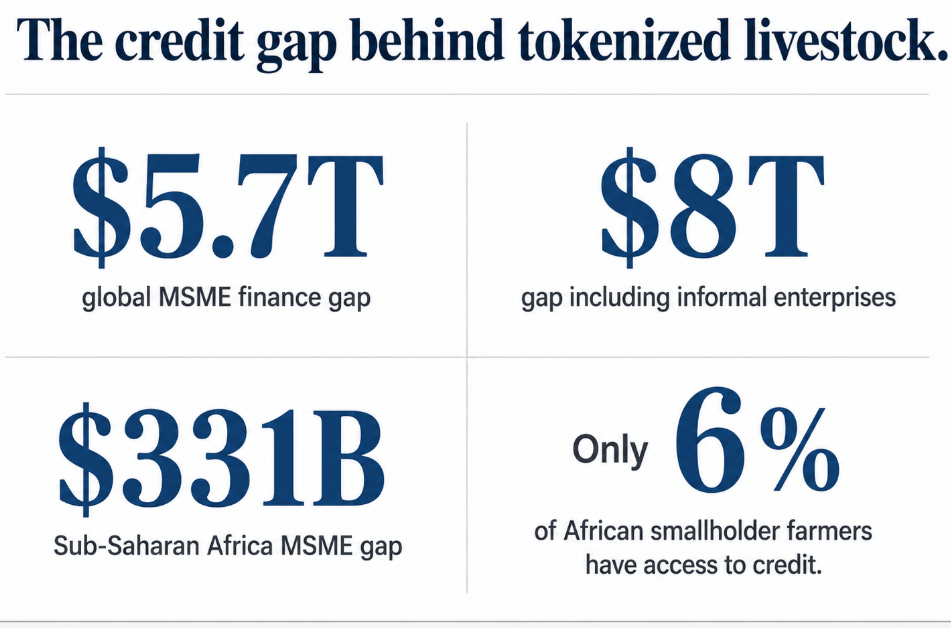
The global gap between what small businesses need to borrow and what they can access runs to $5.7 trillion, climbing to $8 trillion once informal enterprises count too. Sub-Saharan Africa alone accounts for roughly $331 billion of that gap, and the African Development Bank puts credit access among African smallholder farmers at just 6%.
Livestock represents wealth these farmers already own, so the test becomes whether digital identity, collateral registries, insurance and lender claims can connect well enough to turn that wealth into a loan a bank will make.
Where the infrastructure already exists
Ethiopia holds Africa’s largest livestock population, and its central bank already runs an electronic registry that names cattle, camels, sheep, goats and poultry as eligible collateral.
The country is also building an official livestock identification and traceability system, and its 2025-2030 agricultural finance roadmap puts financing demand for livestock costs and herd replenishment at roughly ETB 911 billion.
Ethiopia has both legal recognition and an identity layer taking shape, but lenders still lack reliable valuation, insurance, health data and a clear way to recover the loan if a borrower defaults.
Nigeria carries the largest near-term financing gap in the group, with the IFC putting unmet credit demand among Nigerian small businesses at about $32.2 billion.
A central bank registry already lets farmers pledge livestock, including unborn offspring, and checks whether the same animal has already secured another loan elsewhere.
A separate identification system tags cattle with ear tags and digital passports, and a $500 million livestock program running through 2028 sets aside $70 million specifically for access to finance.
Nigeria already has the registry, the animal identification system and the financing program as separate pieces, with no single product yet connecting them into one loan process.
Kenya’s Movable Property Security Rights Registry runs around the clock, and the country’s agricultural data systems had registered over 7.2 million farmers by 2025.
Lenders registered 34,638 livestock assets as collateral in the year to June 2023, part of roughly KSh 5.1 trillion in credit that movable assets supported overall.
That makes Kenya the group’s control case, with a centralized registry that already accepts livestock at scale there, so tokenization has to prove it lowers the haircut, cuts the interest rate, and confirms an animal is still alive and healthy.
It also has to speed substitution when an animal dies or is sold, and stop lenders from pledging the same animal twice, something the centralized registry may already handle on its own.
Fewer than 200,000 of Pakistan’s 3.2 million small and medium enterprises have formal credit access. Livestock still accounts for about 14.6% of GDP and over 62% of agricultural value added.
In Sindh province, just over 10% of farmers hold formal loans, and roughly 80% of rural livestock holders have no land to pledge. Banks generally decline animals as collateral because livestock insurance barely exists, and the World Bank found only 16% of farmers holding seven to 50 animals qualified as bankable under current conditions.
Death, disease, theft, and drought can still wipe out a herd, and banks need insurance in place before they will accept livestock as collateral at all.
Pakistan makes the clearest case that tokenization needs insurance and reliable veterinary data bundled in. Rural borrowers already risk taking on larger loans against animals that stay uninsured and that a bank could still seize if the loan fails.
| Country | What already exists | Why it matters | Main missing link |
|---|---|---|---|
| Ethiopia | Livestock-eligible collateral registry; animal ID system in development; ETB 911B livestock finance demand | Closest to linking animal identity with legal collateral recognition | Bank products, insurance, valuation, recovery process |
| Nigeria | Collateral registry; cattle ear tags and digital passports; $500M livestock program with $70M for finance | Biggest near-term financing gap and multiple systems already being built | Integration into one lender-ready product |
| Kenya | 24/7 movable collateral registry; 7.2M+ registered farmers; 34,638 livestock collateral assets | Control case showing ordinary registries can already scale | Proof tokenization improves loan terms |
| Pakistan | Large livestock economy; severe SME credit gap | Strongest need for non-land collateral | Insurance, bank acceptance, borrower protection |
| Mongolia | Web-based movable-property registry with livestock pledges at scale | Shows blockchain is not required to record livestock collateral | Evidence tokenization adds value beyond registry records |
Where this goes from here
Mongolia introduced a web-based registry for movable property, and livestock made up 24% of the roughly 90,000 early pledge notices since it was implemented, and later data put livestock near 25% of the 670,000 pledge notices recorded by June 2023, all without a blockchain involved.
Modern electronic registries already handle the core work of recording collateral and setting creditor priority, a point the World Bank has traced directly. Connecting animal identity, health data, insurance coverage, market value and legal claims across separate systems is the work interoperability still has to finish.
A digitally verified animal has to unlock a bigger loan, a lower interest rate, a faster approval, a cheaper insurance premium or a better recovery rate than the same animal gets under ordinary underwriting. Borrowing terms carry the proof, measured in what a bank lends and at what price.
In the bull case, Ethiopia links its animal identity system to its collateral registry, and Nigeria connects its registry, ear-tag system, and financing program into one lending product.
Kenya’s existing scale gives both a template to copy: insurance and veterinary data become part of the underwriting process, haircuts shrink, approval times drop, and loan-to-value ratios climb.
Livestock stops being an asset farmers merely own and becomes one they can borrow against, at scale, across more than one country.
In the bear case, the registries and identification systems never connect. Pakistan’s insurance gap sits as the clearest failure point, and Nigeria’s outcome could tip the same way if its registry, animal IDs and financing program never combine into a loan product.
Farmers take on debt against animals that go uninsured, are disputed within households, or are impossible for a lender to repossess. Disease, drought, or theft can then wipe out that collateral, along with the borrower’s income, in the same event, leaving tokenization as a pilot with no measurable effect on who can borrow.
A normal database in Kenya and Mongolia can already record which animal secures which loan.
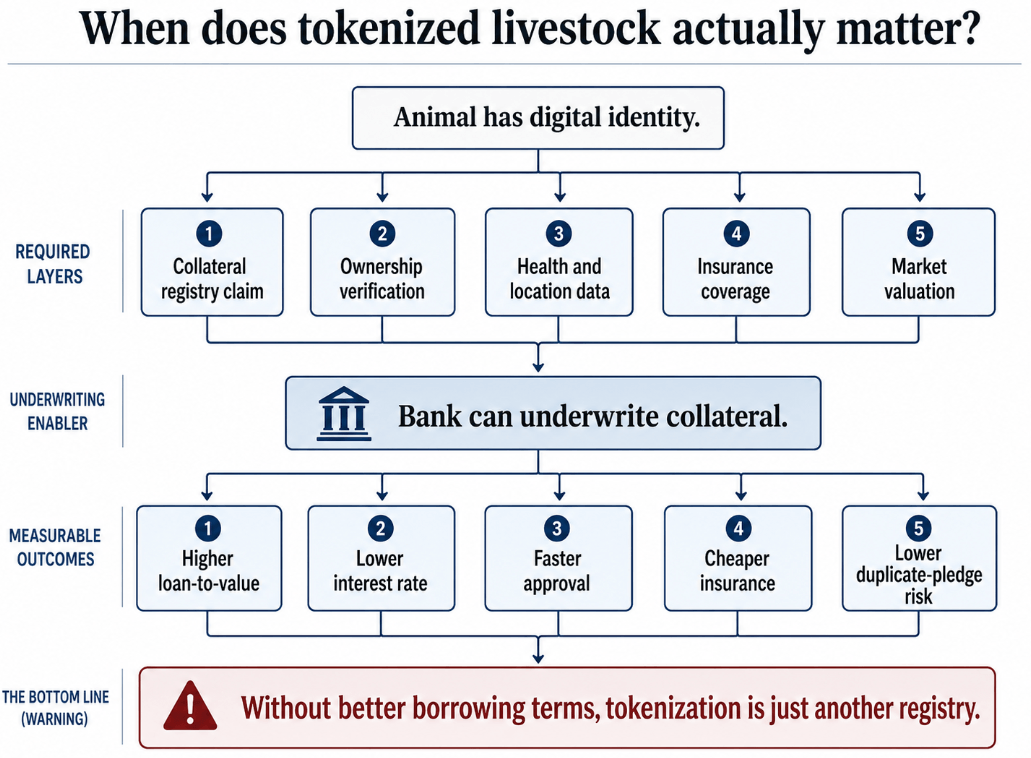
The real test asks whether Ethiopia, Nigeria, Kenya, and Pakistan can connect identity, insurance, and creditor claims into loans that did not exist before, at terms better than farmers get today.
Brazil’s ten cows proved the mechanics work at a small scale, and whether that mechanism becomes rural credit infrastructure for millions of farmers depends on insurance and registries.