
 A trader may do well for a year, the strategy rocks, then they go through a period where they are not as profitable. They are using the exact same strategy but it falls to pieces the next year, why? This article will help you avoid this trap by explaining why you need to monitor volatility and use changing volatility to adjust the risk / reward on trades by editing your stop distance and profit objective.
This article is designed to put the idea in your head that as volatility changes in the market, the way you look at stops and profit targets should change in accordance with it.
Volatility phases
Markets go through different volatility phases and you need to be aware of that. What this basically means is that a market may currently be going through a period of high volatility where it’s moving a lot each day or week, but that won’t last forever and eventually it will calm back down and the daily and weekly ranges will become smaller. If you do not adjust your risk reward profiles accordingly, you will experience some problems…
If you’ve been doing well for a while but now your targets stop getting hit, maybe you just aren’t adjusting them for changing volatility?
As a market’s volatility or daily price swings change, so should your stop losses and targets. Low volatility can seem like the market’s hardly moving at all, but in reality the only thing that is changing is the volatility, so your stop loss and your profit targets need to change accordingly. In the case of lower volatility, your stops and targets would need to be closer than they are during higher volatility.
If, for example, you normally trade with a 40-dollar target and 20-dollar stop and then your targets stop getting hit and you’re losing more than you should have been losing relative to the risk reward, you didn’t adjust your money management as the volatility shifted. As volatility changes, so to does the potential risk reward on any given trade.
If you didn’t adapt and you lost 20$ at your stop when you should have been losing $15, you are going to be angry. Similarly, if you don’t adjust your profit targets for changing volatility you may miss your target where it could have gotten hit if you had a closer target.
Volatility changes as the market moves a different amount on a month-to-month basis and quarter-to -quarter basis. Look at a year ago vs. now, get a feel for how the volatility compares now to then. Money management should be based around current dynamics and should evolve as those dynamics change. Don’t be trading the same way you were 3 years ago if volatility is now half what it was then.
For example, if the average weekly and daily price range changes by 50%, then it should go without saying your stop losses and targets need to change by about 50% too.
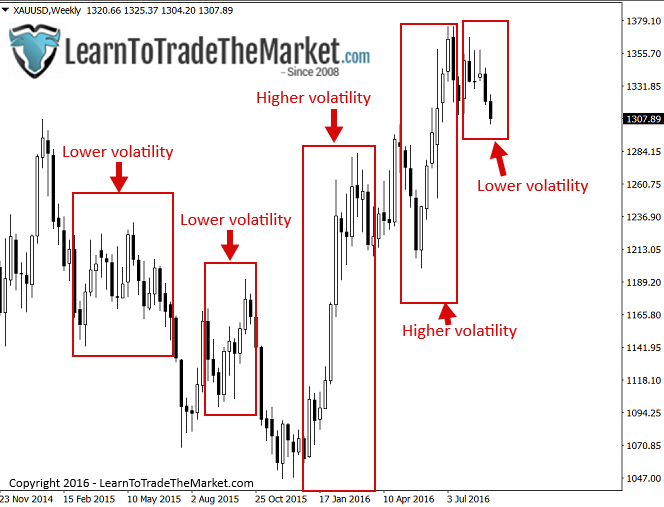
Look at the chart below, you will notice the market shifting from periods of high volatility / big daily moves, to much lower volatility / smaller daily moves. So, when you see these changes in volatility take place, you need to adjust your money management approach accordingly.
As volatility changes, so do horizontal levels
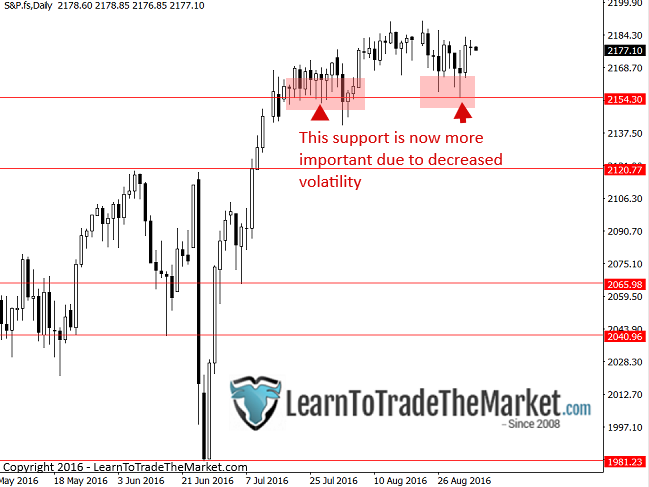
If you have read my articles on how to draw support and resistance levels or how to place stops and targets like a pro trader, you already are aware of the importance of support and resistance levels in stop loss and target placement. However, what I did not get into in those lessons is that as market volatility changes, so will nearby support and resistance levels.
You might be wondering about the ATR or average true range, and where that comes into play here. Well, the ATR is a good tool to use to measure the current / recent market volatility, but we are still going to be using support and resistance levels as important barriers to look at when placing our stops and targets. You don’t want to just place your stop loss based on the ATR, because horizontal levels are always the best places to look at when deciding where to place stop losses.
If you notice a market’s volatility has increased or decreased by a lot recently, you need to also look at where the most recent support and resistance levels are when you go to enter a trade. If a market has recently had a big uptick in volatility, you will have to look at levels further away from current prices, to place your stops. Similarly, if a market has recently had a big drop in volatility, you should be looking closer to recent prices to place your stop losses. Also, remember, as your stop loss changes so must your position sizing on a trade, if you want to maintain the same per-trade dollar risk amount you normally use.
Conclusion
We cannot just jump into the market and totally disregard the fact that it is a constantly changing, dynamic entity. Market volatility is something we must be aware of as traders. We need to make a habit out of observing market volatility every time we analyze the market and make sure we adjust our stop losses and targets as well as position sizes, according to these changing market dynamics.
Learning to recognize and analyze changing market dynamics is a function of understanding price action and learning how to trade from price. This is what I am here for; to help you learn price action trading and to help you make sense of the constantly changing dynamics in the market. Once you fully understand how to read price action, recognizing changing market volatility will be no problem for you, it will come naturally. To learn more, check out my price action trading course and members’ community.