

Views: 40
2025 was a record year for Israeli tech exits.
According to the Israel Innovation Authority’s State of High-Tech 2026 report, Israeli high-tech generated approximately $84 billion in exits in 2025, alongside $85 billion in exports and nearly $15 billion in fundraising. High-tech output grew by 8.2%, and the sector accounted for 58% of Israel’s total exports.
Given that backdrop, the natural question entering 2026 was whether Israeli M&A would slow down after such an exceptional year.
So far, the answer is: not really.
The first half of the year has already produced a long list of strategic acquisitions involving Israeli startups. The buyers include some of the world’s most important technology companies: Apple, Nvidia, Cisco, Palo Alto Networks, CrowdStrike, ServiceNow, Motorola Solutions, Medtronic, PayPal, Akamai, SailPoint, 1Password, Western Union, Nuvei and others.
But the more interesting story is not just that global companies are still buying Israeli startups.
It is that Israeli M&A in 2026 is becoming more layered:
- International acquirers are buying Israeli technology to fill strategic product gaps.
- Multinationals that already have R&D activity in Israel are doubling down through additional acquisitions.
- Israeli and Israeli-rooted companies are increasingly acquiring other Israeli startups.
That third category, the “blue-and-white” M&A story, may be one of the clearest signs of ecosystem maturity.
The biggest Israeli startup M&A deals of 2026 so far
The largest reported transactions in 2026 so far span fintech, defense tech, AI, semiconductors, robotics, medtech and cyber.
| Acquirer | Israeli company acquired | Reported value | Sector / theme |
|---|---|---|---|
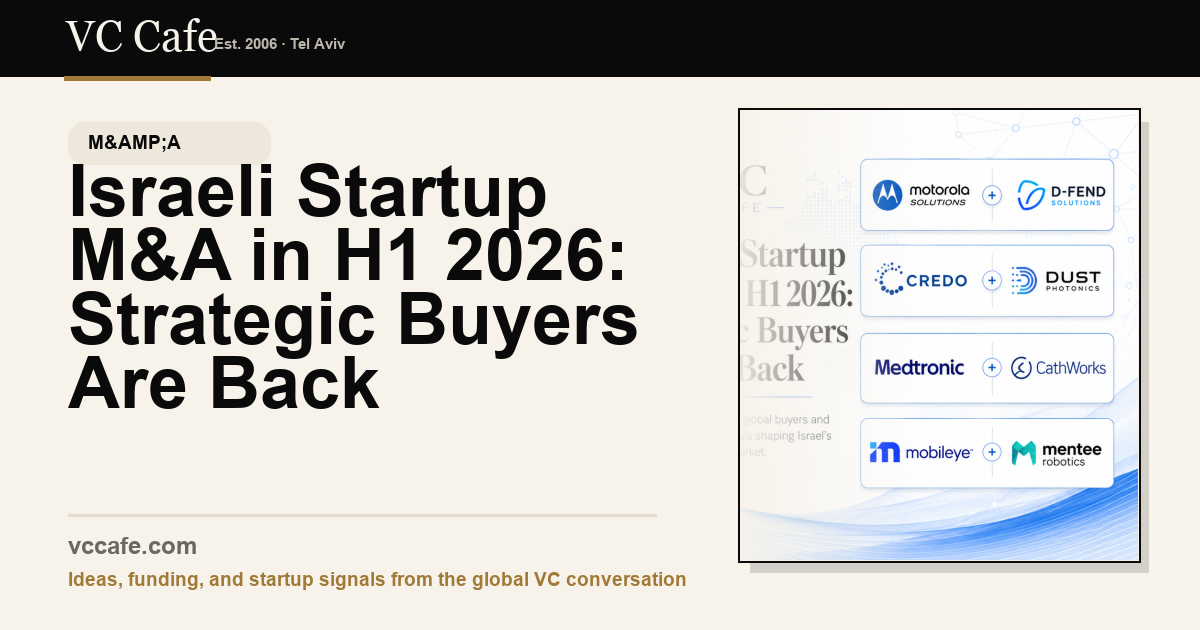
| Nuvei | Payoneer | $2.75B | Fintech / payments |
| Motorola Solutions | D-Fend Solutions | $1.5B | Counter-drone / defense tech |
| Apple | Q.ai | $1.5B | AI audio / wearables |
| Credo | DustPhotonics | Up to $1.3B | Photonics / AI infrastructure |
| Mobileye | Mentee Robotics | ~$900M | Robotics / embodied AI |
| Medtronic | CathWorks | $585M, up to $1B | AI cardiology / medtech |
| Molex | Teramount | $430M | Optical connectivity |
| Cisco | Astrix Security | ~$400M | AI security / non-human identity |
| Palo Alto Networks | Koi | ~$400M | Agentic endpoint security |
| CrowdStrike | Seraphic Security | ~$400M | Browser security |
| ServiceNow | Pyramid Analytics | Hundreds of millions | Analytics / AI workflow |
| Cox Automotive | Fullpath | Hundreds of millions | Automotive retail AI |
| PayPal | Cymbio | Hundreds of millions | Agentic commerce / retail infrastructure |
This is not 2021-style froth. The market is more selective. But that is precisely what makes the 2026 list interesting. Buyers are not simply acquiring growth stories. They are buying strategic capabilities.
What are acquirers buying?
The 2026 list shows clear demand for several categories where Israeli startups have historically been strong — and where global strategic buyers now have urgent needs.
| Theme | Example acquisitions | Why it matters |
|---|---|---|
| AI infrastructure and data | Nvidia ? Illumex; ServiceNow ? Traceloop; ServiceNow ? Pyramid Analytics | Enterprises need data, observability and workflow infrastructure for AI adoption |
| Cybersecurity for the AI era | Cisco ? Astrix; Palo Alto Networks ? Koi; 1Password ? Apono; SailPoint ? Entro Security; Akamai ? LayerX | AI agents, non-human identities and browser-based workflows are creating new security surfaces |
| Defense tech and autonomy | Motorola Solutions ? D-Fend; Elbit ? Bluewhite; Ondas ? Omnisys | Drones, counter-drone systems, autonomy and mission software are moving from niche defense to strategic infrastructure |
| Semiconductors and photonics | Credo ? DustPhotonics; Molex ? Teramount | AI infrastructure is driving demand for faster, more efficient data movement |
| Fintech and commerce | Nuvei ? Payoneer; PayPal ? Cymbio; Fireblocks ? TRES Finance; eToro ? Zengo; Western Union ? GMT | Payments, crypto infrastructure and agentic commerce remain active M&A categories |
| Medtech | Medtronic ? CathWorks; Olympus ? BioProtect; Guardant Health ? MetaSight | Israeli medtech continues to produce strategically valuable regulated technologies |
The common thread is that acquirers are not buying “nice-to-have” products.
They are buying capabilities they believe they need in order to compete.
AI is not a sector. It is the acquisition rationale.
One of the clearest patterns in the 2026 M&A data is that “AI” is no longer just a category. It is the logic behind many transactions.
Some deals are obviously AI-related, such as Nvidia acquiring Illumex, ServiceNow buying Traceloop and Pyramid Analytics, and Apple acquiring Q.ai.
But AI also appears indirectly across the list.
In cybersecurity, AI is changing the threat model. The rise of agents, automated workflows and non-human identities is pushing buyers toward companies that can secure machine-to-machine interactions, enterprise browsers, data access, permissions and automated response.
That explains why companies like Cisco, Palo Alto Networks, SailPoint, 1Password, Akamai, Check Point, Cyera, Torq and Silverfort are all active around AI-era security surfaces.
In commerce, AI is changing how products are discovered and purchased. PayPal’s acquisition of Cymbio points toward a world where retail infrastructure needs to work inside AI assistants, search interfaces and emerging agentic commerce platforms.
In infrastructure, AI is changing the hardware stack. The acquisitions of DustPhotonics and Teramount point to the growing importance of photonics, optical connectivity and data movement in AI data centers.
AI is not one line in the table. It is the connective tissue across the table.
Cyber is still Israel’s main M&A engine
Cybersecurity remains the most obvious export category for Israeli technology.
The 2026 acquirer list includes:
| Acquirer | Company acquired | Reported value | Cyber theme |
|---|---|---|---|
| Cisco | Astrix Security | ~$400M | Non-human identity / AI security |
| Palo Alto Networks | Koi | ~$400M | Agentic endpoint security |
| CrowdStrike | Seraphic Security | ~$400M | Browser security |
| 1Password | Apono | $250M–$300M | Access governance |
| SailPoint | Entro Security | ~$200M | Non-human identity security |
| Akamai | LayerX | $205M | Browser security / AI usage control |
| Check Point | Deepchecks | $10M–$20M | AI security / model evaluation |
| Check Point | Cyclops Security & Cyata | Undisclosed | Exposure management / identity security |
| Cyera | Ryft | $100M–$130M | AI data governance |
| Cyera | Genie Security | ~$50M | Data loss prevention |
| Torq | Jit | ~$70M | AI SOC / security automation |
| Silverfort | Fabrix | Tens of millions | Identity protection |
| Radware | Pynt | Tens of millions | API security testing |
The interesting thing is that this is not simply another year of classic cyber consolidation.
The categories are shifting toward:
- non-human identity
- AI-agent security
- browser security
- data governance
- automated response
- API security
- enterprise access control
That is a strong signal for founders and investors. The next cyber wave is being shaped by AI adoption, and Israeli startups are already being acquired in the emerging subcategories.
Defense tech and autonomy are now mainstream
The acquisition of D-Fend Solutions by Motorola Solutions for $1.5 billion is one of the most important deals of the year.
Counter-drone technology has moved from a specialist defense niche to a mainstream requirement for governments, airports, law enforcement, critical infrastructure and military organizations.
Other deals point in the same direction:
| Acquirer | Company acquired | Reported value | Theme |
|---|---|---|---|
| Motorola Solutions | D-Fend Solutions | $1.5B | Counter-drone systems |
| Elbit Systems | Bluewhite | Undisclosed | AI robotics / autonomy |
| Ondas | Omnisys | ~$200M | Defense software / AI mission planning |
| Mobileye | Mentee Robotics | ~$900M | Robotics / embodied AI |
The convergence of drones, robotics, autonomy, defense software and AI is becoming one of the defining technology themes of the next decade.
Israel has a natural advantage in this area because of its defense ecosystem, engineering talent and operational urgency. But the category is no longer local or niche. It is global.
Semiconductors and photonics are having a moment
For years, Israeli tech was often described through the lens of software: cyber, SaaS, fintech, gaming, adtech and enterprise software.
The 2026 M&A list shows that the “harder” layers of technology are becoming strategic again.
| Acquirer | Company acquired | Reported value | Strategic layer |
|---|---|---|---|
| Credo | DustPhotonics | Up to $1.3B | Photonic connectivity for AI infrastructure |
| Molex | Teramount | $430M | Optical chip connectivity |
This matters because AI infrastructure is not only about GPUs.
As AI clusters scale, data movement becomes a bottleneck. The physical movement of data between chips, servers and data centers is now a core part of the AI infrastructure stack.
That creates demand for optical connectivity, photonics, advanced semiconductors and networking infrastructure.
This also connects to one of the themes in the Israel Innovation Authority’s 2026 report: the renewed importance of deep tech, defense tech, space, quantum and AI infrastructure in the next generation of Israeli companies.
In a world where software moats are being compressed by AI, deep technical infrastructure may become more attractive again.
The “blue-and-white” M&A story
One of the most interesting patterns in the 2026 data is not just that global strategic buyers are active in Israel. It is that Israeli and Israeli-rooted companies are also becoming more active acquirers of Israeli startups.
This matters because it points to ecosystem maturity.
In earlier phases of the Startup Nation, the classic exit narrative was simple: build in Israel, sell to a US or European technology giant, become that company’s local R&D center.
That model still exists, and it remains important. But the 2026 data shows a more layered picture.
Israeli category leaders are now using M&A to consolidate talent, product capabilities and strategic wedges.
| Israeli / Israeli-rooted acquirer | Company acquired | Reported value | Strategic rationale |
|---|---|---|---|
| Mobileye | Mentee Robotics | ~$900M | Robotics and embodied AI |
| Fireblocks | TRES Finance | ~$130M | Crypto accounting and financial infrastructure |
| eToro | Zengo | ~$70M | Crypto wallet and self-custody |
| Cyera | Ryft | $100M–$130M | AI data governance |
| Cyera | Genie Security | ~$50M | Data loss prevention |
| Torq | Jit | ~$70M | AI SOC and security automation |
| Check Point | Deepchecks | $10M–$20M | AI security and model evaluation |
| Check Point | Cyclops Security & Cyata | Undisclosed | Exposure management and identity security |
| Silverfort | Fabrix | Tens of millions | Identity protection for the AI era |
| Radware | Pynt | Tens of millions | API security testing |
| AUI | Quack AI | ~$15M | AI customer-support automation |
| Elbit Systems | Bluewhite | Undisclosed | Autonomous robotics and defense |
| Amdocs | Yess | Undisclosed | Enterprise AI agents |
| Commit | Savannah | Several million | Software talent and outsourcing |
This is a healthy sign.
A mature ecosystem should not only produce startups that get acquired by foreign multinationals. It should also produce local champions that acquire teams, absorb technical capabilities and build larger platforms from within the ecosystem.
The rise of blue-and-white M&A also creates a local recycling mechanism. Founders, employees, capital and expertise do not simply leave the ecosystem after an exit. They often stay connected to it, either through the acquiring company’s Israeli operations or through the next generation of founders, operators and angel investors.
Are acquisitions still a route to multinational R&D in Israel?
Another question is whether foreign acquirers are using Israeli M&A to enter the market for the first time, or whether they are doubling down on existing Israel R&D operations.
The answer is both.
A public-source review of the 2026 acquirer list suggests that at least 40% of the international strategic acquirers already had a meaningful Israel R&D or technology operation before making their 2026 acquisition.
This group includes companies such as Cisco, Nvidia, Palo Alto Networks, Apple, PayPal, Medtronic, Akamai, ServiceNow, CrowdStrike, Nuvei, Ondas and Motorola Solutions.
That matters.
It means M&A is not only an entry mechanism. For many multinationals, Israel is already a strategic product and engineering base, and acquisitions are a way to keep feeding that base with new technology and talent.
At the same time, the list also includes buyers for whom the 2026 transaction appears to be a first or early Israeli foothold. 1Password’s acquisition of Apono was reported as its first acquisition in Israel and a basis for establishing a development center. Guardant Health’s acquisition of MetaSight was described as creating its first R&D center outside the United States.
That dual pattern is one of the defining features of Israeli M&A:
| Acquirer type | What the acquisition represents | Examples |
|---|---|---|
| Foreign buyer entering Israel | Acquisition creates or expands an Israeli R&D foothold | 1Password ? Apono; Guardant Health ? MetaSight |
| Multinational already active in Israel | Acquisition deepens an existing R&D or product base | Cisco ? Astrix; Nvidia ? Illumex; Apple ? Q.ai; PayPal ? Cymbio |
| Israeli / Israeli-rooted acquirer | Local category leader consolidating talent and product | Mobileye ? Mentee; Fireblocks ? TRES; Cyera ? Ryft; Torq ? Jit |
| Strategic platform buyer | Acquisition fills a specific product or market gap | Motorola Solutions ? D-Fend; Medtronic ? CathWorks; Credo ? DustPhotonics |
This is the real story of H1 2026. Israeli M&A is not only about exits. It is about where global technology companies choose to build, and where Israeli category leaders choose to deepen their advantage.
The macro context: strength, but also warning signs
The Israel Innovation Authority’s 2026 report gives important context for the M&A data.
On the positive side, Israeli high-tech returned to growth in 2025. The sector generated approximately $85 billion in exports, $84 billion in exits, and nearly $15 billion in fundraising. High-tech output grew by 8.2%, reached NIS 352 billion, and accounted for 18.3% of Israel’s GDP. The sector also accounted for 58% of Israel’s exports.
This is a remarkable level of resilience given the security, political and economic environment.
But the report also highlights structural concerns.
For the first time in more than a decade, the number of R&D employees in Israeli high-tech declined. The share of private Israeli high-tech company employees based in Israel has also continued to fall, from 69% in 2019 to 62% by March 2026.
That is the tension at the heart of Israeli tech today.
The ecosystem is producing valuable companies and attracting strategic buyers. But more activity, management and R&D are also moving abroad.
M&A can strengthen Israel as a global R&D hub when acquirers keep and grow local teams. But it can also accelerate the movement of decision-making abroad if local operations are not preserved and scaled.
That makes the blue-and-white M&A trend even more important. When Israeli companies acquire locally, the center of gravity is more likely to remain in the ecosystem.
What does this mean for founders?
For founders, the 2026 M&A data offers several practical lessons.
| Lesson | What it means |
|---|---|
| Strategic value matters more than vanity metrics | Acquirers are buying capabilities that solve urgent product, infrastructure or security needs |
| AI creates acquisition opportunities beyond AI apps | The biggest opportunities may be in data, workflow, identity, security, infrastructure and hardware |
| Category depth still wins | Israel remains strong in cyber, defense tech, semiconductors, fintech and medtech |
| Potential acquirers should be mapped early | Founders should understand where their product fits in the roadmap of strategic buyers |
| Local acquirers matter too | Israeli category leaders can be credible buyers, not only foreign multinationals |
| M&A is a recycling mechanism | Exits return talent, capital and experience to the ecosystem |
The companies being acquired in 2026 are not just “interesting startups”. Many own a strategic wedge. That is the bar in the current market.
What does this mean for investors?
For investors, the data reinforces several themes.
Cyber is still strong, but the next generation of cyber is shifting toward AI-era surfaces: non-human identity, agent security, browser control, data governance and automated response.
Deep tech is becoming more investable as the AI infrastructure buildout creates demand for semiconductors, photonics, robotics, autonomy and defense technologies.
Fintech is not dead, but the strongest exits are likely to come from infrastructure, compliance, payments, crypto rails, embedded finance and agentic commerce rather than consumer financial apps alone.
And perhaps most importantly: M&A remains a core path to liquidity in Israeli venture. The IPO window may reopen selectively, but the acquisition market is already active. Strategic buyers are still willing to pay for Israeli technology when it solves a strategic problem.
The bottom line
After a record-breaking 2025, 2026 is already showing that Israeli startup M&A remains active, strategic and globally relevant.
But the nature of the market is changing. This is not a broad, easy exit environment. It is a selective market where buyers are looking for specific capabilities: AI infrastructure, cyber for the agentic era, defense and autonomy, photonics, fintech rails, medtech, data and workflow automation.
The acquirer list is also a map of global demand. Apple, Nvidia, Cisco, Palo Alto Networks, CrowdStrike, Motorola Solutions, Medtronic, PayPal and others are showing what they believe matters. At the same time, Israeli companies like Mobileye, Fireblocks, Cyera, Torq, Check Point, eToro and Elbit are showing that Israel is not only a source of acquisition targets. It is also producing acquirers.
That is the more important signal. Israeli M&A in 2026 is not just about exits.
It is about the next structure of the ecosystem: foreign multinationals doubling down, new buyers entering Israel, and local champions consolidating from within.

He is a former General Partner at Google Ventures (GV) in Europe, former head of Google for Entrepreneurs in Europe, and founding head of Campus London, Google’s first startup hub. Eze writes on Israeli tech, venture capital, artificial intelligence, and founder strategy.
He is also the founder of Techbikers, a nonprofit that brings together the startup ecosystem on cycling challenges in support of Room to Read.