

Eze Vidra
May 7, 2026
Updated May 7, 2026

Views: 56
Chokepoints are non-substitutable, critical nodes in the global economy dominated by a single state or small coalition. These,,invisible chokepoints, such as the U.S. dollar, advanced semiconductors, and maritime insurance, allow for economic leverage without military force
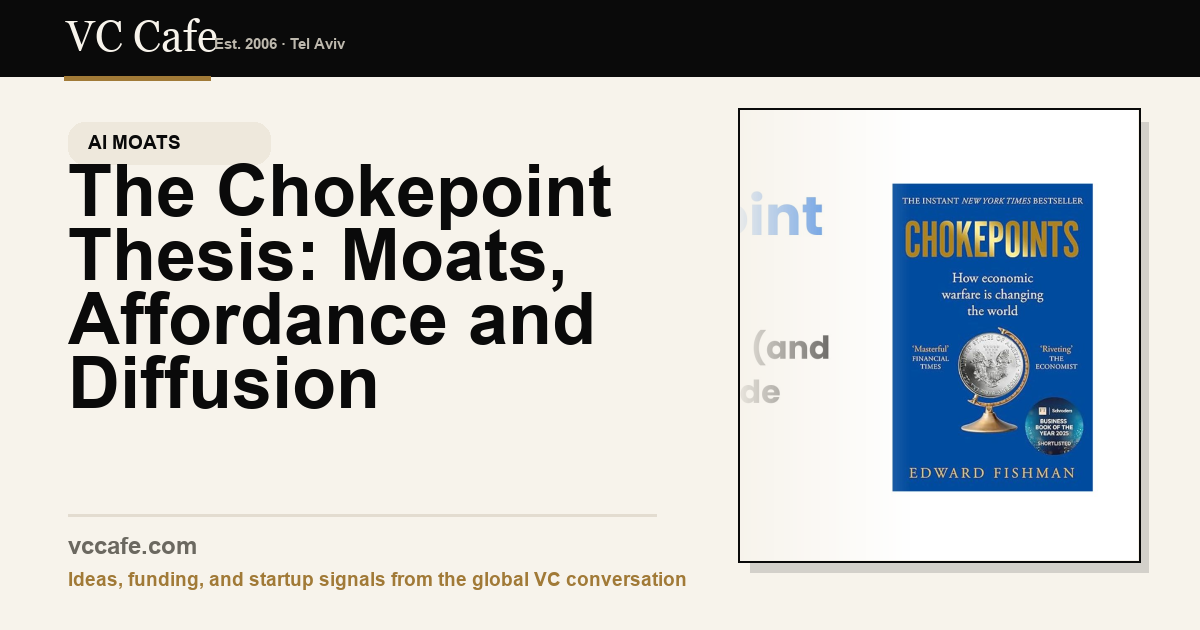
Edward Fishman, in his 2025 book Chokepoints: American Power in the Age of Economic Warfare
Historically, geopolitical power was defined by control over physical chokepoints – routes essential for movement and trade, such as the Strait of Hormuz or the Suez Canal. Today, in the age of economic warfare, the definition has evolved. A modern chokepoint is defined as a non-substitutable domain dominated by a single actor or small coalition, where there are few, if any, alternatives. Rather than relying on naval blockades, power is now wielded through control over intangible networks: the US dollar, financial clearing systems like SWIFT, and advanced microchip supply chains.
For us in the venture capital ecosystem, this concept maps perfectly onto the technology landscape. In the startup world, a chokepoint is the scarcest or most constrained part of a process that determines the output of the whole system. The most valuable startups of the coming decade will not win simply by having the loudest marketing or the most abstractly intelligent AI; they will win by quietly inserting themselves into the structural bottlenecks that govern how decisions get made, how value flows, and how risk is managed.
Here is how we at VC Cafe are evaluating these strategic chokepoints – both the negative bottlenecks founders must survive, and the positive moats they must build.
Negative Chokepoints: Navigating Existential Risks
Just as nations can be suffocated by infrastructural dominance, startups are highly vulnerable to external chokepoints dominated by massive incumbents or regulators. VCs must assess where a portfolio company is at the mercy of a non-substitutable domain.
- The Compute Supply Chain: High-tech value chains are deeply complex and reliant on advanced semiconductors. An entire industry forced to rely on a single dominant chipmaker (like Nvidia) faces a severe negative chokepoint. If access to compute is restricted, whether by supply shortages or export controls aimed at preserving strategic advantages, startups without prioritised access will struggle to survive.
- Financial and Regulatory Infrastructure: Tech founders are highly dependent on underlying financial networks, which can be weaponised. We saw this historically with the original “Operation Choke Point,” where the DOJ pressured banks to cut off specific industries from the financial system. More recently, the alleged “Choke Point 2.0” has sparked fears among venture-backed tech and crypto founders who report being abruptly “debanked” without due process, clear rules, or paths for appeal. When startups rely entirely on centralised financial clearing systems, a classic invisible chokepoint, they can be cut off overnight.
Positive Chokepoints: Chokepoint Capitalism and the AI Opportunity
Conversely, when a startup successfully captures a structural bottleneck, they execute a playbook known as “chokepoint capitalism.” This involves systematically locking in buyers and suppliers, eliminating competition, and creating an environment where they can extract outsized value. Platforms like Amazon and Spotify have built massive monopsony markets where they are functionally the only buyers in a creative labor market.
In the B2B and enterprise software space, value naturally accumulates at bottlenecks for three core reasons:
- Control of Decision Flow: By becoming the default environment where critical choices happen, you shape how decisions are framed and executed.
- Systems of Record: Tools that live at bottlenecks log actions and outcomes, creating compounding, proprietary behavioral data that competitors cannot easily copy.
- High Switching Costs: Once an enterprise wraps its culture, governance, and trust around your tool, you transition from being a “tool in the stack” to becoming the stack itself.
But how do founders build these structural bottlenecks today, especially in an era where base-level AI capabilities are rapidly advancing and “services is the new software”?
As Pat Grady, Sonya Huang, and Konstantine Buhler shared their most recent learnings on AI in their Sequoia AI Ascent 2026 keynote, AI applications builders should look past the raw, shifting technology and focus on customer-centric strategy, nicknamed the MAD framework:
- Moats. In a revolution of computation, capabilities change faster than customers do. One cannot build a moat based purely on the newest tech because it will be obsolete tomorrow. Therefore, founders must approach the value chain customer-back, wrapping themselves entirely around the customer’s data and workflows to build durable defensibility.
- Affordance. Affordance is a design term for an object that doesn’t need to be explained – like a hammer, people simply know what to do with it. While foundation models are incredibly powerful, they currently offer limited affordance to average, non-technical buyers. The immense opportunity lies in creating paths of least resistance for specific customers to solve their specific business problems.
- Diffusion. The rate of capability creation is far outpacing capability adoption. The widening gap between what foundation models can actually do and what enterprises are actively using represents a massive opportunity for application-layer startups.

How to think about chokepoints for startups
In an era where synthetic intelligence is becoming abundant, the competition is no longer for the best standalone model, but for control of the narrowest points in a system.
The MAD framework offers a blueprint for how startups can capture these points. By using deep customer affordance to bridge the diffusion gap, founders can transform raw AI capabilities into proprietary workflows. We want to back founders who understand the microeconomics of their industry’s supply chains, who can carefully engineer their way out of negative chokepoints, and who can quietly insert themselves into the structural bottlenecks where actual value is created.

He is a former General Partner at Google Ventures (GV) in Europe, former head of Google for Entrepreneurs in Europe, and founding head of Campus London, Google’s first startup hub. Eze writes on Israeli tech, venture capital, artificial intelligence, and founder strategy.
He is also the founder of Techbikers, a nonprofit that brings together the startup ecosystem on cycling challenges in support of Room to Read.