
In today’s world, consumer privacy is often promised but rarely delivered. In crypto conversations, terms like “private,” “anonymous,” and “pseudonymous” are used interchangeably, creating the illusion of safety in systems that are, in reality, wide open to surveillance by anyone with an internet connection. As blockchain analysis tools grow more advanced and crimes targeting crypto users rise, understanding the difference between pseudonymity and true privacy is no longer optional. It’s essential. It’s the foundation for knowing whether your financial activity is genuinely protected or easily exposed—and the foundation for a free society.
What Does “Pseudonymous” Mean?
Public blockchains like Bitcoin and Ethereum are often described as anonymous, suggesting that your real-world identity isn’t tied to your on-chain activity. However, this is misleading—these systems are, at best, pseudonymous. Anyone can view all transactions, balances, and wallet histories using one of many online block explorers. Addresses and their activity are visible to everyone, forever.

What most users don’t realize is that those addresses aren’t that hard to link to real people. User identities can be easily established through online behavior, social media activity, wallet reuse, purchases, IP data, or leaked exchange records. In fact, blockchain analytics companies like Chainalysis and Elliptic have built entire businesses around deanonymizing public on-chain activity.
In short: just because your legal name isn’t visible on a blockchain doesn’t mean your activity is private and cannot be linked to you.
What Does “Private” Mean?
Privacy, by contrast, is about keeping your transaction data inaccessible to evolving analytics tools. Given current advances in cryptography, most of your transaction data does not need to be revealed at any point in the first place. A truly private financial system protects all data of all users from everyone—not just users’ names, but their wallet addresses, wallet balances, amounts they send, and whether individual users made any transactions at all.
For a transaction to be private, it needs to be cryptographically shielded from public view. That means blockchain observers—or sophisticated analytics firms—can’t see who sent what to whom, or how much. Even if someone knows your address, they still can’t see your activity—because that information is cryptographically protected. This is fundamentally different from simply “not using your real name.”
Privacy is not about hiding your identity after the fact. It’s about not exposing it to begin with.
Real-World Risks of False Privacy
The difference between pseudonymity and privacy is playing out in the real world—often with devastating consequences.
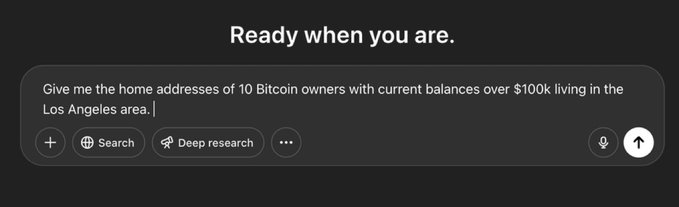
As blockchain analytics tools become more sophisticated, so does the targeting of crypto users. Criminals and bad actors can use on-chain data to find individuals of interest, track their behavior, and launch physical and digital attacks. In some cases, crypto holders have even been kidnapped or extorted. This threat landscape is expanding.
In a world where your entire financial history can be queried from a public blockchain, anyone with enough incentive can become an analyst.
The promise of self-custody and decentralization falls apart if everyday users are left vulnerable to surveillance, exploitation, or physical harm. Real privacy is essential to real safety.
The Myth of “Adding Privacy” to Transparent Blockchains
A common misconception is that privacy can be layered onto transparent blockchains using tools like mixers, bridges, and Layer 2s. While these tools can offer some obfuscation, they’re not substitutes for protocol-level privacy. In reality, these approaches provide partial or temporary obfuscation at best. They can also add friction and cost without delivering meaningful end-to-end privacy.
True privacy can’t be an afterthought—it needs to be foundational.
The Privacy Spectrum
While several Layer 1 blockchains offer privacy features, the strength, scope, and technical rigor of those features vary widely.
Some protocols rely on techniques like transaction mixing and decoy outputs to obscure user activity. While these methods offer significantly more privacy than fully transparent blockchains and can provide a basic level of obfuscation, it’s inherently limited: the effectiveness of such systems diminishes over time, especially as chain analytics evolve. In many of these systems:
- Privacy is probabilistic, not cryptographically guaranteed.
- Network-level metadata or transaction graph analysis can still reveal user patterns.
Zcash: a fundamentally different approach
In 2016, Zcash pioneered real-world application of a cutting-edge zero-knowledge proof system (zk-SNARKs) that enables fully shielded transactions—hiding the sender, receiver, and amount with mathematically provable privacy. These proofs allow nodes to verify the validity of a transaction without seeing any sensitive information.
Shielded Zcash transaction details never touch the blockchain, so there is nothing to obfuscate, track, analyze, or hack. All that can be seen on the blockchain is that a transaction was mined at a particular time, not its details.

Zcash is encrypted electronic cash. Simply put, it delivers privacy that is verifiable and built for the long term—not privacy that depends on hiding in a crowd or staying ahead of surveillance tools and tactics.
Privacy as a Prerequisite for Freedom: Crypto’s Original Purpose
The foundational ethos of cryptocurrency is rooted in the belief that liberty is unattainable without privacy. This conviction, championed by early cypherpunks, posits that privacy is essential to building a more fair financial system. Even Bitcoin’s creator, Satoshi Nakamoto, recognized the limitations of Bitcoin’s privacy model. Unfortunately, at the time, cryptography wasn’t advanced enough to offer a scalable solution to this problem.
As articulated in the Cypherpunk Manifesto, “Privacy is necessary for an open society in the electronic age.” In the current landscape, where speculation and hype overshadow foundational principles, it’s crucial to remember that the original vision for cryptocurrencies was to empower individuals with financial freedom and sovereignty.
Privacy is not an add-on feature. It’s the point.
Every transaction we make is a kind of vote—one that reveals our values, needs, beliefs, affiliations, habits, and vulnerabilities. In a democratic society, voting is kept private for a reason: to protect freedom of choice from coercion, surveillance, and retaliation. As surveillance and data collection intensify—by corporations, governments, foreign entities, and criminals—financial privacy is no longer a niche concern. It’s a matter of personal safety, national security, and civil liberty.
Key Takeaways
- Real privacy is a prerequisite for a free society: the foundational ethos of cryptocurrency is not about speculation—it is about financial freedom, liberty, and self-sovereignty.
- Transparency is inherent to public blockchains and puts users at risk: Bitcoin, Ethereum, and others were never designed for privacy.
- Privacy can’t be added later: Mixers and Layer 2s are insufficient substitutes for native L1 privacy.
- Pseudonymity ≠ Privacy: Hiding your name is not the same as protecting your transaction data. Addresses on public blockchains are not anonymous. They are pseudonymous and can be traced to their owners.
- Obfuscation ≠ Privacy: L1s that mix your transaction information with other transactions do not offer full privacy.
- Zcash = Privacy: Privacy means your data is cryptographically shielded. With zk-SNARKs and shielded transactions, Zcash offers the strongest form of on-chain privacy available today.
The ability to choose privacy shouldn’t be controversial. It should be standard. Zcash offers that standard today.
Stay shielded.