

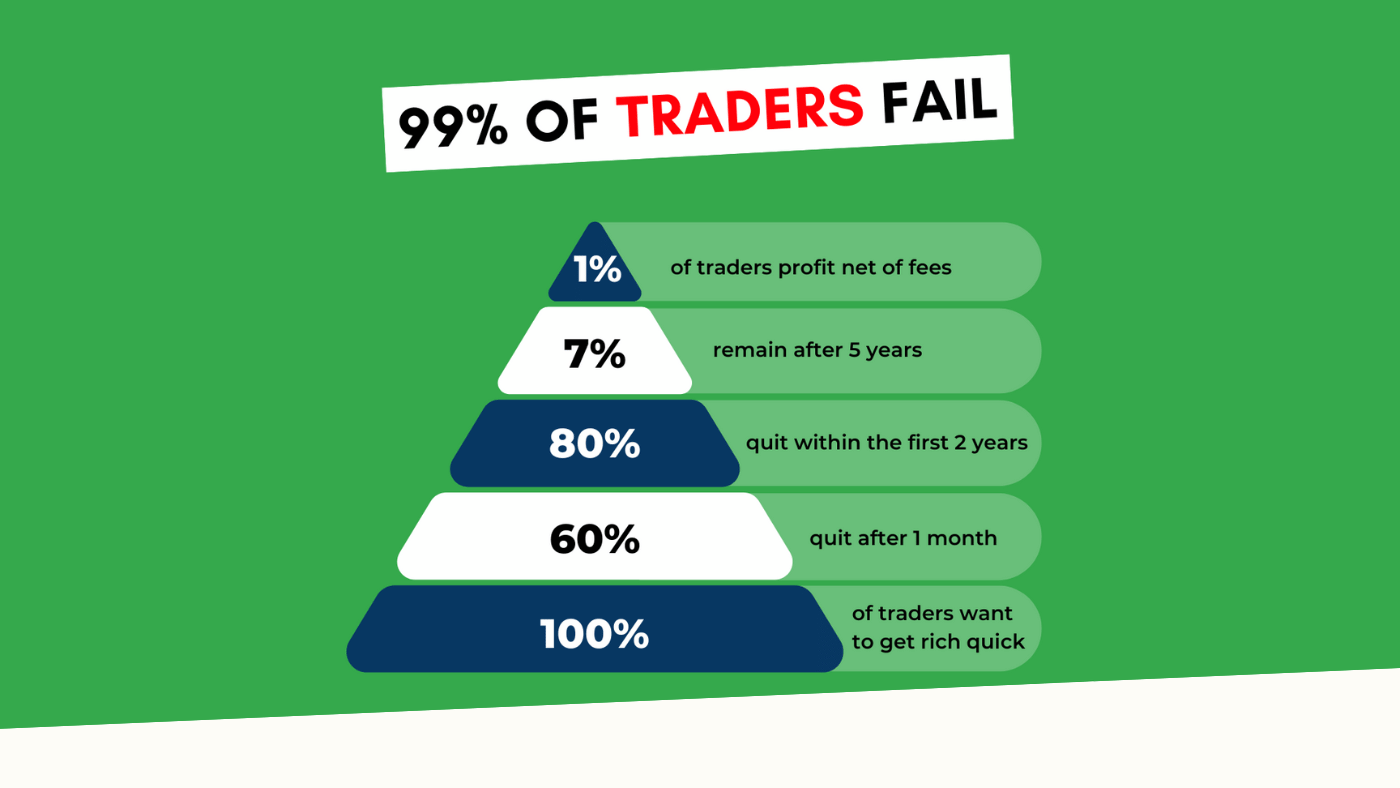
“95% of all traders fail” is the most commonly used trading related statistic around the internet. But no research paper exists that proves this number right. Research even suggests that the actual figure is much, much higher. In the following article we’ll show you 24 very surprising statistics economic scientists discovered by analyzing actual broker data and the performance of traders. Some explain very well why most traders lose money.
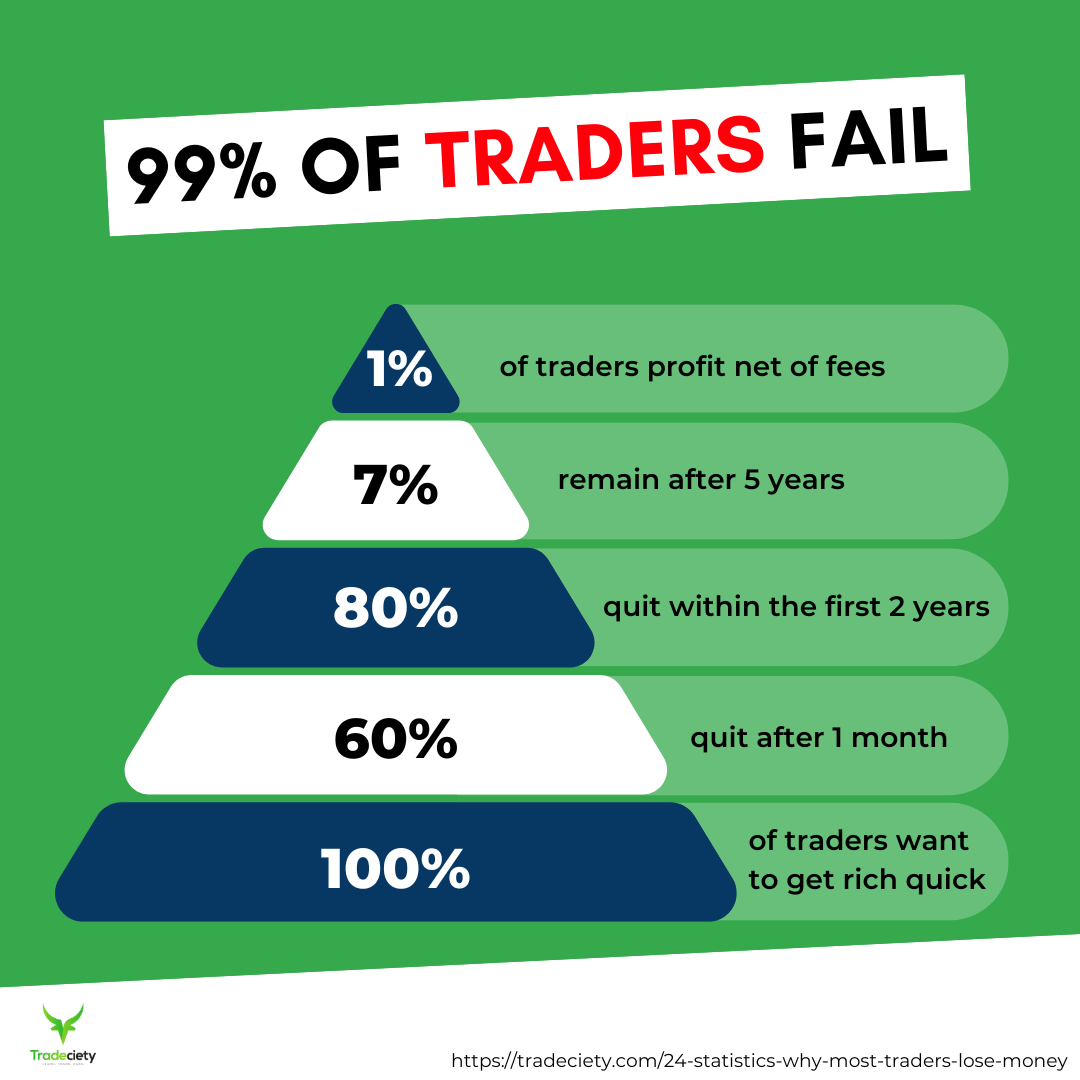
- 80% of all day traders quit within the first two years. 1
- Among all day traders, nearly 40% day trade for only one month. Within three years, only 13% continue to day trade. After five years, only 7% remain. 1
- Traders sell winners at a 50% higher rate than losers. 60% of sales are winners, while 40% of sales are losers.2
- The average individual investor underperforms a market index by 1.5% per year. Active traders underperform by 6.5% annually. 3
- Day traders with strong past performance go on to earn strong returns in the future. Though only about 1% of all day traders are able to predictably profit net of fees. 1
- Traders with up to a 10 years negative track record continue to trade. This suggests that day traders even continue to trade when they receive a negative signal regarding their ability. 1
- Profitable day traders make up a small proportion of all traders – 1.6% in the average year. However, these day traders are very active – accounting for 12% of all day trading activity. 1
- Among all traders, profitable traders increase their trading more than unprofitable day traders. 1
- Poor individuals tend to spend a greater proportion of their income on lottery purchases and their demand for lottery increases with a decline in their income. 4
- Investors with a large differential between their existing economic conditions and their aspiration levels hold riskier stocks in their portfolios. 4
- Men trade more than women. And unmarried men trade more than married men. 5
- Poor, young men, who live in urban areas and belong to specific minority groups invest more in stocks with lottery-type features. 5
- Within each income group, gamblers underperform non-gamblers. 4
- Investors tend to sell winning investments while holding on to their losing investments. 6
- Trading in Taiwan dropped by about 25% when a lottery was introduced in April 2002. 7
- During periods with unusually large lottery jackpot, individual investor trading declines. 8
- Investors are more likely to repurchase a stock that they previously sold for a profit than one previously sold for a loss. 9
- An increase in search frequency [in a specific instrument] predicts higher returns in the following two weeks. 10
- Individual investors trade more actively when their most recent trades were successful.11
- Traders don’t learn about trading. “Trading to learn” is no more rational or profitable than playing roulette to learn for the individual investor.1
- The average day trader loses money by a considerable margin after adjusting for transaction costs.
- [In Taiwan] the losses of individual investors are about 2% of GDP.
- Investors overweight stocks in the industry in which they are employed.
- Traders with a high-IQ tend to hold more mutual funds and larger number of stocks. Therefore, benefit more from diversification effects.
Conclusion: Why Most Traders Lose Money Is Not Surprising Anymore
After going over these 24 statistics it’s very obvious to tell why traders fail. More often than not trading decisions are not based on sound research, tested trading methods or their trading journal  , but on emotions, the need for entertainment and the hope to make a fortune in no time.
What traders always forget is that trading is a profession and requires skills that need to be developed over the years. Therefore, be mindful of your trading decisions and the view you have on trading. Don’t expect to be a millionaire by the end of the year, but keep in mind the possibilities trading online has.
————
– 1Barber, Lee, Odean (2010): Do Day Traders Rationally Learn About Their Ability?
– 2Odean (1998): Volume, volatility, price, and profit when all traders are above average
– 3Barber, & Odean (2000): Trading is hazardous to your wealth: The common stock investment performance of individual investors
– 4 Kumar: Who Gambles In The Stock Market?
– 5 Barber, Odean (2001): Boys will be boys: Gender, overconfidence, and common stock investment
– 6Calvet, L. E., Campbell, J., & Sodini P. (2009). Fight or flight? Portfolio rebalancing by individual investors.
–7Barber, B. M., Lee, Y., Liu, Y., & Odean, T. (2009). Just how much do individual investors lose by trading?
– 8Gao, X., & Lin, T. (2011). Do individual investors trade stocks as gambling? Evidence from repeated natural experiments
– 9Strahilevitz, M., Odean, T., & Barber, B. (2011). Once burned, twice shy: How naïve learning, counterfactuals, and regret affect the repurchase of stocks previously sol.
– 10Da, Z., Engelberg, J., & Gao, P. (2011). In search of attention
– 11De, S., Gondhi, N. R. & Pochiraju, B. (2010). Does sign matter more than size? An investigation into the source of investor overconfidence